
A. W. Kinglake, by W. Tuckwell
Transcribed from the 1902 Edition by David Price,best doll cribs for 6 year olds under 30 dollars [email protected]
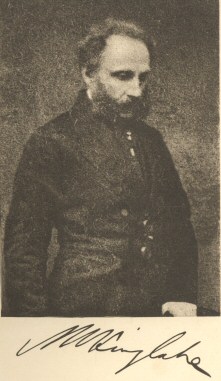
A. W. KINGLAKE
A BIOGRAPHICAL AND
LITERARY STUDY
BY
REV. W. TUCKWELL
AUTHOR OF“TONGUES IN TREES,” “WINCHESTER FIFTY
YEARS AGO,” “REMINISCENCES OFOXFORD,” ETC.
ἁμέραιδ᾿ἐπίλοιποιμάρτυρεςσοφώτατρο

LONDON
GEORGE BELL AND SONS,
1902
p. ivCHISWICKPRESS: CHARLES WHITTINGHAM AND CO.
TOOKS COURT, CHANCERY LANE,LONDON.
p.vPREFACE
It is just eleven years since Kinglake passed away, and hislife has not yet been separately memorialized. A few yearsmore, and the personal side of him would be irrecoverable, thoughby personality, no less than by authorship, he made hiscontemporary mark. When a tomb has been closed forcenturies, the effaced lineaments of its tenant can bere-coloured only by the idealizing hand of genius, as Scott drewClaverhouse, and Carlyle drew Cromwell. But, to thebiographer of the lately dead, men have a right to say, as Saulsaid to the Witch of Endor, “Call up Samuel!” In your study of a life so recent as Kinglake’s, give us,if you choose, some critical synopsis of his monumental writings,some salvage from his ephemeral and scattered papers; trace somuch of his youthful training as shaped the development of hischaracter; depict, with wise restraint, his political and publiclife: but also, and above all, re-clothe him “in his habitas he lived,” as friends and p. viassociates knew him; recover histraits of voice and manner, his conversational wit or wisdom,epigram or paradox, his explosions of sarcasm and hiseccentricities of reserve, his words of winningness and acts ofkindness: and, since one half of his life was social, introduceus to the companions who shared his lighter hour and evoked hisfiner fancies; take us to the Athenæum“Corner,” or to Holland House, and flash on us atleast a glimpse of the brilliant men and women who formed thesetting to his sparkle; “dic in amicitiam coeant etfoedera jungant.”
This I have endeavoured to do, with such aid as I couldcommand from his few remaining contemporaries. His lettersto his family were destroyed by his own desire; on those writtento Madame Novikoff no such embargo was laid, nor does she believethat it was intended. I have used these sparingly, and allextracts from them have been subjected to her censorship. If the result is not Attic in salt, it is at any rate Roman inbrevity. I send it forth with John Bunyan’s homelyaspiration:
And may its buyer have no cause to say,
His money is but lost or thrown away.
p.viiCONTENTS
CHAP. |
| PAGE |
I. | Early Years | 1 |
II. | “Eothen” | 20 |
III. | Literary and ParliamentaryLife | 33 |
IV. | “The Invasion of theCrimea” | 56 |
V. | Madame Novikoff | 90 |
VI. | Later Days, and Death | 111 |
| Index | 149 |
p. ixLISTOF ILLUSTRATIONS
Kinglake in the lateFifties | Frontispiece |
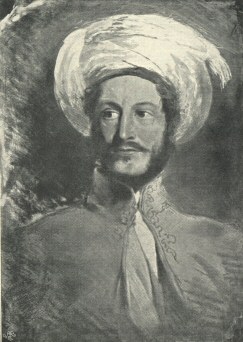
Eliot Warburton | 14 |
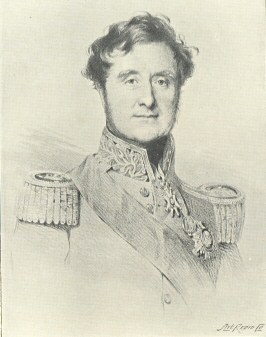
Lord Raglan | 40 |
Madame Novikoff | 92 |
Kinglake in the EarlySeventies | 128 |
p. 1CHAPTERI
EARLY YEARS
The fourth decade of the deceasedcentury dawned on a procession of Oriental pilgrims, variouslyqualified or disqualified to hold the gorgeous East in fee, who,with bakshîshin their purses, a theory in theirbrains, an unfilled diary-book in their portmanteaus, sought outthe Holy Land, the Sinai peninsula, the valley of the Nile,sometimes even Armenia and the Monte Santo, and returned home toemit their illustrated and mapped octavos. We have the typedelineated admiringly in Miss Yonge’s“Heartsease,” [1] bitterly in MissSkene’s “Use and Abuse,” facetiously in theClarence Bulbul of “Our Street.” “Hangit! has not p.2everybody written an Eastern book? I should like tomeet anybody in society now who has not been up to the SecondCataract. My Lord Castleroyal has done one—an honestone; my Lord Youngent another—an amusing one; my LordWoolsey another—a pious one; there is the ‘Cutlet andthe Cabob’—a sentimental one; Timbuctoothen—ahumorous one.” Lord Carlisle’s honesty, LordNugent’s fun, Lord Lindsay’s piety, failed to floattheir books. Miss Martineau, clear, frank, unemotionalCurzon, fuddling the Levantine monks with rosoglio that he mightfleece them of their treasured hereditary manuscripts, even EliotWarburton’s power, colouring, play of fancy, have yieldedto the mobility of Time. Two alone out of the gallantcompany maintain their vogue to-day: Stanley’s “Sinaiand Palestine,” as a Fifth Gospel, an inspired ScriptureGazetteer; and “Eothen,” as a literary gem of purestray serene.
In 1898 a reprint of the first edition was given to thepublic, prefaced by a brief eulogium of the book and a slightnotice of the author. It brought to the writer of the“Introduction” not only kind and indulgent criticism,but valuable corrections, fresh facts, p. 3clues to further knowledge. These last have been carefully followed out. The unwarystatement that Kinglake never spoke after his first failure inthe House has been atoned by a careful study of all his speechesin and out of Parliament. His reviews in the“Quarterly” and elsewhere have been noted;impressions of his manner and appearance at different periods ofhis life have been recovered from coæval acquaintances; hisfriend Hayward’s Letters, the numerous allusions in LordHoughton’s Life, Mrs. Crosse’s lively chapters in“Red Letter Days of my Life,” Lady Gregory’sinteresting recollections of the Athenæum Club in Blackwoodof December, 1895, the somewhat slender notice in the“Dictionary of National Biography,” have all beencarefully digested. From these, and, as will be seen, fromother sources, the present Memoir has been compiled; anendeavour—sera tamen—to lay before thecountless readers and admirers of his books a fairly adequateappreciation, hitherto unattempted, of their author.
I have to acknowledge the great kindness of Canon WilliamWarburton, who examined his brother Eliot’s diaries on mybehalf, obtained information from Dean Boyle and Sir p. 4M. Grant Duff,cleared up for me not a few obscure allusions in the“Eothen” pages. My highly valued friend, Mrs.Hamilton Kinglake, of Taunton, his sister-in-law, last survivingrelative of his own generation, has helped me with facts which noone else could have recalled. To Mr. Estcott, his oldacquaintance and Somersetshire neighbour, I am indebted forrecollections manifold and interesting; but above all I tenderthanks to Madame Novikoff, his intimate associate andcorrespondent during the last twenty years of his life, who hassupplemented her brilliant sketch of him in “La NouvelleRevue” of 1896 by oral and written information lavish inquantity and of paramount biographical value. Kinglake’s external life, his literary and politicalcareer, his speeches, and the more fugitive productions of hispen, were recoverable from public sources; but his personal andprivate side, as it showed itself to the few close intimates whostill survive, must have remained to myself and others meagre,superficial, disappointing, without Madame Novikoff’sunreserved and sympathetic confidence.
Alexander William Kinglake was descended p. 5from an oldScottish stock, the Kinlochs, who migrated to England with KingJames, and whose name was Anglicized into Kinglake. Lateron we find them settled on a considerable estate of their own atSaltmoor, near Borobridge, whence towards the close of theeighteenth century two brothers, moving southward, made theirhome in Taunton—Robert as a physician, William as asolicitor and banker. Both were of high repute, both begatfamous sons. From Robert sprang the eminent Parliamentarylawyer, Serjeant John Kinglake, at one time a contemporary withCockburn and Crowder on the Western Circuit, and William ChapmanKinglake, who while at Trinity, Cambridge, won the Latin verseprize, “Salix Babylonica,” the English verse prizeson “Byzantium” and the “Taking ofJerusalem,” in 1830 and 1832. Of William’s sonsthe eldest was Alexander William, author of “Eothen,”the youngest Hamilton, for many years one of the mostdistinguished physicians in the West of England. “Eothen,” as he came to be called, was born atTaunton on the 5th August, 1809, at a house called “TheLawn.” His father, a sturdy Whig, died at the age ofninety through injuries received in the hustings crowd p. 6of a contestedelection. His mother belonged to an old Somersetshirefamily, the Woodfordes of Castle Cary. She, too, lived to agreat age; a slight, neat figure in dainty dress, full of antiquecharm and grace. As a girl she had known Lady HesterStanhope, who lived with her grandmother, Lady Chatham, at BurtonPynsent, her own father, Dr. Thomas Woodforde, being LadyChatham’s medical attendant. [6] The futureprophetess of the Lebanon was then a wild girl, scouring thecountryside on bare-backed horses; she showed great kindness toMary Woodforde, afterwards Kinglake’s mother. It wasas his mother’s son that she received him long afterwardsat Djoun. To his mother Kinglake was passionately attached;owed to her, as he tells us in “Eothen,” his home inthe p. 7saddleand his love for Homer. A tradition is preserved in thefamily that on the day of her funeral, at a churchyard five milesaway, he was missed from the household group reassembled in themourning home; he was found to have ordered his horse, andgalloped back in the darkness to his mother’s grave. Forty years later he writes to Alexander Knox: “The deathof a mother has an almost magical power of recalling the home ofone’s childhood, and the almost separate world that restsupon affection.” Of his two sisters, one was wellread and agreeably talkative, noted by Thackeray as the cleverestwoman he had ever met; the other, Mrs. Acton, was a delightfulold esprit fort, as I knew her in the sixties,“pagan, I regret to say,” but not a little resemblingher brother in the point and manner of her wit. The familymoved in his infancy to an old-fashioned handsome “WiltonHouse,” adjoining closely to the town, but standing amidspacious park-like grounds, and inhabited in after years byKinglake’s younger brother Hamilton, who succeeded hisuncle in the medical profession, and passed away, amid deep anduniversal regret, in 1898. Here during the thirties SydneySmith was a frequent and a welcome visitor; p. 8it was inanswer to old Mrs. Kinglake that he uttered his audaciousmoton being asked if he would object, as a neighbouringclergyman had done, to bury a Dissenter: “Not buryDissenters? I should like to be burying them allday!”
Taunton was an innutrient foster-mother, arida nutrix,for such young lions as the Kinglake brood. Two hundredyears before it had been a prosperous and famous place, itswoollen and kersey trades, with the population they supported,ranking it as eighth in order among English towns. Itsinhabitants were then a gallant race, republican in politics,Puritan in creed. Twice besieged by Goring and Lumford, ithad twice repelled the Royalists with loss. It was thecentre of Monmouth’s rebellion and of Jeffrey’svengeance; the suburb of Tangier, hard by its ancient castle,still recalls the time when Colonel Kirke and his regiment of“Lambs” were quartered in the town. But longbefore the advent of the Kinglakes its glory had departed; itsmanufactures had died out, its society become Philistine andbourgeois—“little men who walk in narrowways”—while from pre-eminence in electoral venalityamong English boroughs it p. 9was saved only by the near proximityof Bridgewater. A noted statesman who, at a later period,represented it in Parliament, used to say that by only one familybesides Dr. Hamilton Kinglake’s could he be received withany sense of social or intellectual equality.
Not much, however, of Kinglake’s time was given to hisnative town: he was early sent to the Grammar School at OtterySt. Mary’s, the “Clavering” of“Pendennis,” whose Dr. Wapshot was George Coleridge,brother of the poet. He was wont in after life to speak ofthis time with bitterness; a delicate child, he was starved oninsufficient diet; and an eloquent passage in“Eothen” depicts his intellectual fall from thevaried interests and expanding enthusiasm of liberal hometeaching to the regulation gerund-grinding and Procrusteandiscipline of school. “The dismal change is ordained,and then—thin meagre Latin with small shreds and patches ofGreek, is thrown like a pauper’s pall over all your earlylore; instead of sweet knowledge, vile, monkish, doggerelgrammars and graduses, dictionaries and lexicons, and horribleodds and ends of dead languages are given you for your portion,and down you fall, from Roman story to a three-inch scrap of‘Scriptores p.10Romani,’—from Greek poetry, down, down tothe cold rations of ‘Poetæ Græci,’ cut upby commentators, and served out by school-masters!”
At Eton—under Keate, as all readers of“Eothen” know—he was contemporary withGladstone, Sir F. Hanmer, Lords Canning and Dalhousie, Selwyn,Shadwell. He wrote in the “Etonian,” createdand edited by Mackworth Praed; and is mentioned in Praed’spoem on Surly Hall as
“Kinglake, dear to poetry,
And dear to all his friends.”
Dr. Gatty remembers his “determined pale face”;thinks that he made his mark on the river rather than in theplaying fields, being a good oar and swimmer. His greatfriend at school was Savile, the “Methley” of histravels, who became successively Lord Pollington and Earl ofMexborough. The Homeric lore which Methley exhibited in theTroad, is curiously illustrated by an Eton story, that in apugilistic encounter with Hoseason, afterwards an Indian Cavalryofficer, while the latter sate between the rounds upon hissecond’s knee, Savile strutted about the ring, spoutingHomer.
Kinglake entered at Trinity, Cambridge, in p. 111828, amongan exceptionally brilliant set—Tennyson, Arthur Hallam,John Sterling, Trench, Spedding, Spring Rice, Charles Buller,Maurice, Monckton Milnes, J. M. Kemble, Brookfield,Thompson. With none of them does he seem in hisundergraduate days to have been intimate. Probably then, asafterwards, he shrank from camaraderie, sharedByron’s distaste for “enthusymusy”; naturallycynical and self-contained, was repelled by the spiritualfervour, incessant logical collision, aggressive tilting atabuses of those young “Apostles,” already
“Yearning for the large excitement that thecoming years would yield,
Eager-hearted as a boy when first he leaves his father’sfield,”
waxing ever daily, as Sterling exhorted, “in religionand radicalism.” He saw life differently; morepractically, if more selfishly; to one rhapsodizing about the“plain living and high thinking” ofWordsworth’s sonnet, he answered: “You know that youprefer dining with people who have good glass and china andplenty of servants.” For Tennyson’s poetry heeven then felt admiration; quotes, nay, misquotes, in“Eothen,” from the little p. 12known “Timbuctoo”; [12a] and from “Locksley Hall”;and supplied long afterwards an incident adopted by Tennyson in“Enoch Arden,”
“Once likewise in the ringing of his ears
Though faintly, merrily—far and far away—
He heard the pealing of his parish bells,” [12b]
p. 13fromhis own experience in the desert, when on a Sunday, amidoverpowering heat and stillness, he heard the Marlen bells ofTaunton peal for morning church. [13]
In whatever set he may have lived he made his mark atCambridge. Lord Houghton remembered him as an orator at theUnion; and speaking to Cambridge undergraduates fifty yearslater, after enumerating the giants of his student days,Macaulay, Praed, Buller, Sterling, Merivale, he goes on to say:“there, too, were Kemble and Kinglake, the historian of ourearliest civilization and of our latest war; Kemble asinteresting an individual as ever was portrayed by the dramaticgenius of his own race; Kinglake, as bold a man-at-arms inliterature as ever confronted public opinion.” Weknow, too, that not many years after leaving Cambridge hereceived, and refused, a solicitation to stand as Liberalrepresentative of the University in Parliament. He was, infact, as far as any of his contemporaries from acquiescing insocial conventionalisms and shams. To the end of his lifehe chafed at such restraint: “when pressed to stay incountry houses,” he writes in 1872, “I have had thep. 14franknessto say that I have not discipline enough.” Repeatedlyhe speaks with loathing of the “stale civilization,”the “utter respectability,” of European life; [14a] longed with all his soul for theexcitement and stir of soldiership, from which hisshortsightedness debarred him; [14b] rushed off againand again into foreign travel; set out immediately on leavingCambridge, in 1834, for his first Eastern tour, “to fortifyhimself for the business of life.” Methley joined himat Hamburg, and they travelled by Berlin, Dresden, Prague,Vienna, to Semlin, where his book begins. LordPollington’s health broke down, and he remained to winterat Corfu, while Kinglake pursued his way alone, returning toEngland in October, 1835. [14c] On hisreturn he read for the Chancery Bar along with his friend EliotWarburton, under Bryan p. 15Procter, a Commissioner of Lunacy,better known by his poet-name, Barry Cornwall; his acquaintancewith both husband and wife ripening into life-longfriendship. Mrs. Procter is the “Lady ofBitterness,” cited in the “Eothen”Preface. As Anne Skepper, before her marriage, she was muchadmired by Carlyle; “a brisk witty prettyish clear eyedsharp tongued young lady”; and was the intimate, amongmany, especially of Thackeray and Browning. In epigrammaticpower she resembled Kinglake; but while his acrid sayings wereemitted with gentlest aspect and with softest speech; while, likeByron’s Lambro:
“he wasthe mildest mannered man
That ever scuttled ship or cut a throat,
With such true breeding of a gentleman,
You never could divine his real thought,”
her sarcasms rang out with a resonant clearness that enforcedand aggravated their severity. That two persons so stronglyresembling each other in capacity for rival exhibition, or formutual exasperation, should have maintained so firm a friendship,often surprised their acquaintance; she explained it by sayingthat she and Kinglake sharpened one another like two knives;that, in the words of Petruchio,
p.16“Where two raging fires meet together,
They do consume the thing that feeds their fury.”
Crabb Robinson, stung by her in a tender place, his boastfuliterative monologues on Weimar and on Goethe, said that of allmen Procter ought to escape purgatory after death, having tastedits fulness here through living so many years with Mrs. Procter;“the husbands of the talkative have great rewardhereafter,” said Rudyard Kipling’s Lama. And Ihave been told by those who knew the pair that there was truth aswell as irritation in the taunt. “A graceful Prefaceto ‘Eothen,’” wrote to me a now famous lady whoas a girl had known Mrs. Procter well, “made friendlycompany yesterday to a lonely meal, and brought back memories ofMr. Kinglake’s kind spoiling of a raw young woman, and ofthe wit, the egregious vanity, the coarseness, the kindness, ofthat hard old worldling our Lady of Bitterness.” Inthe presence of one man, Tennyson, she laid aside hershrewishness: “talking with Alfred Tennyson lifts me out ofthe earth earthy; a visit to Farringford is like a retreat to thereligious.” A celebrity in London for fifty years,she died, witty and vigorous to the last, in 1888. “You and I and Mr. Kinglake,” she says to LordHoughton, p.17“are all that are left of the goodly band thatused to come to St. John’s Wood; Eliot Warburton, Motley,Adelaide, Count de Verg, Chorley, Sir Edwin Landseer, myhusband.” “I never could write a book,”she tells him in another letter, “and one strong reason fornot doing so was the idea of some few seeing how poor itwas. Venables was one of the few; I need not say that youwere one, and Kinglake.”
Kinglake was called to the Chancery Bar, and practisedapparently with no great success. He believed that hisreputation as a writer stood in his way. When, in 1845,poor Hood’s friends were helping him by gratuitous articlesin his magazine, “Hood’s Own,” Kinglake wroteto Monckton Milnes refusing to contribute. He will send£10 to buy an article from some competent writer, but willnot himself write. “It would be seriously injuriousto me if the author of ‘Eothen’ wereaffichédas contributing to a magazine. Myfrailty in publishing a book has, I fear, already hurt me in myprofession, and a small sin of this kind would bring on me stilldeeper disgrace with the solicitors.”
Twice at least in these early years he travelled. “Mr. Kinglake,” writes Mrs. Procter p. 18in 1843,“is in Switzerland, reading Rousseau.” And inthe following year we hear of him in Algeria, accompanying St.Arnaud in his campaign against the Arabs. The mingledinterest and horror inspired in him by this extra-ordinary manfinds expression in his “Invasion of the Crimea” (ii.157). A few, a very few survivors, still remember hisappearance and manners in the forties. The eminent husbandof a lady, now passed away, who in her lifetime gave Sundaydinners at which Kinglake was always present, speaks of him assensitive, quiet in the presence of noisy people, ofBrookfield and the overpowering Bernal Osborne; liking theircompany, but never saying anything worthy of remembrance. Apopular old statesman, still active in the House of Commons,recalls meeting him at Palmerston, Lord Harrington’s seat,where was assembled a party in honour of Madame Guiccioli and hersecond husband, the Marquis de Boissy, and tells me that heattached himself to ladies, not to gentlemen, nor ever joined ingeneral tattle. Like many other famous men, he passedthrough a period of shyness, which yielded to women’stactfulness only. From the first they appreciated him;“if you were as gentle as your friend Kinglake,” p. 19writes Mrs.Norton reproachfully to Hayward in the sulks. Anothercoæval of those days calls him handsome—an epithet Ishould hardly apply to him later—slight, not tall, sharpfeatured, with dark hair well tended, always modishly dressedafter the fashion of the thirties, the fashion of Bulwer’sexquisites, or of H. K. Browne’s “NicholasNickleby” illustrations; leaving on all who saw him animpression of great personal distinction, yet with an air ofyouthful abandonwhich never quite left him: “He waspale, small, and delicate in appearance,” says Mrs.Simpson, Nassau Senior’s daughter, who knew him to the endof his life; while Mrs. Andrew Crosse, his friend in the Crimeandecade, cites his finely chiselled features and intellectualbrow, “a complexion bloodless with the pallor not ofill-health, but of an old Greek bust.”
p.20CHAPTER II
“EOTHEN”
“Eothen” appeared in1844. Twice, Kinglake tells us, he had essayed the story ofhis travels, twice abandoned it under a sense of strongdisinclination to write. A third attempt was induced by anentreaty from his friend Eliot Warburton, himself projecting anEastern tour; and to Warburton in a characteristic preface thenarrative is addressed. The book, when finished, went theround of the London market without finding a publisher. Itwas offered to John Murray, who cited his refusal of it as thegreat blunder of his professional life, consoling himself withthe thought that his father had equally lacked foresight thirtyyears before in declining the “Rejected Addresses”;he secured the copyright later on. It was published in theend by a personal friend, Ollivier, of Pall Mall, Kinglake paying£50 to cover risk of loss; even worse terms than wereobtained by p.21Warburton two years afterwards from Colburn, who ownedin the fifties to having cleared £6,000 by “TheCrescent and the Cross.” The volume was an octavo of418 pages; the curious folding-plate which forms the frontispiecewas drawn and coloured by the author, and was compared by thecritics to a tea-tray. In front is Moostapha the Tatar; thetwo foremost figures in the rear stand for accomplished Mysseri,whom Kinglake was delighted to recognize long afterwards as aflourishing hotel keeper in Constantinople, and Steel, theYorkshire servant, in his striped pantry jacket, “lookingout for gentlemen’s seats.” Behind are“Methley,” Lord Pollington, in a broad-brimmed hat,and the booted leg of Kinglake, who modestly hid his figure by atree, but exposed his foot, of which he was very proud. Ofthe other characters, “Our Lady of Bitterness” wasMrs. Procter, “Carrigaholt” was Henry Stuart Burtonof Carrigaholt, County Clare. Here and there are allusions,obvious at the time, now needing a scholiast, which have not inany of the reprints been explained. In their ride throughthe Balkans they talked of old Eton days. “We bulliedKeate, and scoffed at Larrey Miller and Okes; we rode alongloudly laughing, p.22and talked to the grave Servian forest as though it werethe Brocas clump.” [22] Keate requiresno interpreter; Okes was an Eton tutor, afterwards Provost ofKing’s. Larrey or Laurie Miller was an old tailor inKeate’s Lane who used to sit on his open shop-board, facingthe street, a mark for the compliments of passing boys; asfrolicsome youngsters in the days of Addison and Steele, as HighSchool lads in the days of Walter Scott, were accustomed to“smoke the cobler.” The Brocas was a meadowsacred to badger-baiting and cat-hunts. The badgers werekept by a certain Jemmy Flowers, who charged sixpence for each“draw”; Puss was turned out of a bag and chased bydogs, her chance being to reach and climb a group of trees nearthe river, known as the “Brocas Clump.” Of thequotations, “a Yorkshireman hippodamoio” (p. 35) is,I am told, an obiter dictumof Sir Francis Doyle. “Striving to attain,” etc. (p. 33), is taken notquite correctly from Tennyson’s“Timbuctoo.” Our crew were “a solemncompany” (p. 57) is probably a reminiscence of “wewere a gallant company” in “The Siege ofCorinth.” For “‘the own armchair’of our Lyrist’s ‘Sweet Lady p.23Anne’” (p. 161) see the poem, “My ownarmchair” in Barry Cornwall’s “EnglishLyrics.” “Proud Marie of Anjou” (p. 96)and “single-sin —” (p. 121), areunintelligible; a friend once asked Kinglake to explain theformer, but received for answer, “Oh! that is a privatething.” It may, however, have been a pet name forlittle Marie de Viry, Procter’s niece, and thechère amieof his verse, whom Eothen must have metoften at his friend’s house. The St. Simonians of p.83 were the disciples of Comte de St. Simon, a Parisian reformerin the latter part of the eighteenth century, who endeavoured toestablish a social republic based on capacity and labour. Père Enfantin was his disciple. The “mysticmother” was a female Messiah, expected to become the parentof a new Saviour. “Sir Robert once said a goodthing” (p. 93), refers possibly to Sir Robert Peel, notfamous for epigram, whose one good thing is said to have beenbestowed upon a friend before Croker’s portrait in theAcademy. “Wonderful likeness,” said the friend,“it gives the very quiver of the mouth.” “Yes,” said Sir Robert, “and the arrow comingout of it.” Or it may mean Sir Robert Inglis,Peel’s successor at Oxford, more noted for p. 24his genialkindness and for the perpetual bouquet in his buttonhole at adate when such ornaments were not worn, than for capacity toconceive and say good things. In some mischievous linesdescribing the Oxford election where Inglis supplanted Peel,Macaulay wrote
“And then said all the Doctors sitting inthe Divinity School,
Not this man, but Sir Robert’—now Sir Robert was afool.”
But in the fifth and later editions Kinglake altered it to“Sir John.”
By a curious oversight in the first two editions (p. 41)Jovewas made to gaze on Troy from Samothrace; it wasrightly altered to Neptune in the third; and “eagle eye ofJove” in the following sentence was replaced by“dread Commoter of our globe.” The phrase“a natural Chiffney-bit” (p. 109), I have foundunintelligible to-day through lapse of time even to professionalequestrians and stable-keepers. Samuel Chiffney, a famousrider and trainer, was born in 1753, and won the Derby onSkyscraper in 1789. He managed the Prince of Wales’sstud, was the subject of discreditable insinuations, and wascalled before the Jockey p. 25Club. Nothing was provedagainst him, but in consequence of the fracasthe Princesevered his connection with the Club and sold his horses. Chiffney invented a bit named after him; a curb with twosnaffles, which gave a stronger bearing on the sides of ahorse’s mouth. His rule in racing was to keep a slackrein and to ride a waiting race, not calling on his horse tillnear the end. His son Samuel, who followed him, observedthe same plan; from its frequent success the term “Chiffneyrush” became proverbial. In his ride through thedesert (p. 169) Kinglake speaks of his “nativebells—the innocent bells of Marlen, that never before sentforth their music beyond the Blaygon hills.” Marlenbells is the local name for the fine peal of St. Mary Magdalen,Taunton. The Blaygon, more commonly called the BlagdonHills, run parallel with the Quantocks, and between them lies thefertile Vale of Taunton Deane. “Damascus,” hesays, on p. 245, “was safer than Oxford”; and adds anote on Mr. Everett’s degree which requirescorrection. It is true that an attempt was made tonon-placetMr. Everett’s honorary degree in theOxford Theatre in 1843 on the ground of his being a Unitarian;not true that it succeeded. p. 26It was a conspiracy by the younglions of the Newmania, who had organized a formidable oppositionto the degree, and would have created a painful scene even ifdefeated. But the Proctor of that year, Jelf, happened tobe the most-hated official of the century; and the furious groansof undergraduate displeasure at his presence, continuing unabatedfor three-quarters of an hour, compelled Wynter, theVice-Chancellor, to break up the Assembly, without recitation ofthe prizes, but not without conferring the degrees in dumb show:unconscious Mr. Everett smilingly took his place in red gownamong the Doctors, the Vice-Chancellor asserting afterwards, whatwas true in the letter though not in the spirit, that he did nothear the non-placets. So while Everett was obnoxiousto the Puseyites, Jelf was obnoxious to the undergraduates; thecannonade of the angry youngsters drowned the odium of thetheological malcontents; in the words of Bombastes:
“Another lion gave another roar,
And the first lion thought the last a bore.”
The popularity of “Eothen” is a paradox: itfascinates by violating all the rules which p. 27conventionassigns to viatic narrative. It traverses the mostaffecting regions of the world, and describes no one of them: theTroad—and we get only his childish raptures overPope’s “Homer’s Iliad”;Stamboul—and he recounts the murderous services rendered bythe Golden Horn to the Assassin whose serail, palace,council chamber, it washes; Cairo—but the Plague shuts outall other thoughts; Jerusalem—but Pilgrims have vulgarizedthe Holy Sepulchre into a Bartholomew Fair. He gives useverywhere, not history, antiquities, geography, description,statistics, but only Kinglake, only his own sensations,thoughts, experiences. We are told not what the desertlooks like, but what journeying in the desert feels like. From morn till eve you sit aloft upon your voyaging camel; therisen sun, still lenient on your left, mounts vertical anddominant; you shroud head and face in silk, your skin glows,shoulders ache, Arabs moan, and still moves on the sighing camelwith his disjointed awkward dual swing, till the sun once moredescending touches you on the right, your veil is thrown aside,your tent is pitched, books, maps, cloaks, toilet luxuries,litter your spread-out rugs, you feast on scorching p. 28toast and“fragrant” [28] tea, sleep sound andlong; then again the tent is drawn, the comforts packed,civilization retires from the spot she had for a single nightannexed, and the Genius of the Desert stalks in.
Herein, in these subjective chatty confidences, is part of thespell he lays upon us: while we read we are inthe East:other books, as Warburton says, tell us aboutthe East,this is the East itself. And yet in his company we arealways Englishmenin the East: behind Servian, Egyptian,Syrian, desert realities, is a background of English scenery,faint and unobtrusive yet persistent and horizoning. In theDanubian forest we talk of past school-days. The Balkanplain suggests an English park, its trees planted as if to shutout “some infernal fellow creature in the shape of anew-made squire”; Jordan recalls the Thames; the GalileanLake, Windermere; the Via Dolorosa, Bond Street; the fresh toastof the desert bivouac, an Eton breakfast; the hungry questingjackals are the place-hunters of Bridgewater and Taunton; theDamascus gardens, a neglected English p. 29manor from which the“family” has been long abroad; in the fierce, drydesert air are heard the “Marlen” bells of home,calling to morning prayer the prim congregation in far-off St.Mary’s parish. And a not less potent factor in thecharm is the magician’s self who wields it, shown througheach passing environment of the narrative; the shy, haughty,imperious Solitary, “a sort of Byron in the desert,”of cultured mind and eloquent speech, headstrong and not alwaysamiable, hiding sentiment with cynicism, yet thereforeirresistible all the more when he condescends to endear himselfby his confidence. He meets the Plague and its terrors likea gentleman, but shows us, through the vicarious torments of thecowering Levantine that it was courage and coolness, notinsensibility, which bore him through it. A foe tomarriage, compassionating Carrigaholt as doomed to travel“Vetturini-wise,” pitying the Dead Sea goatherd forhis ugly wife, revelling in the meek surrender of the three youngmen whom he sees “led to the altar” in Suez, he isstill the frank, susceptible, gallant bachelor, observantly andcritically studious of female charms: of the magnificent yetformidable Smyrniotes, eyes, brow, nostrils, throat, sweetly p. 30turned lips,alarming in their latent capacity for fierceness, pride, passion,power: of the Moslem women in Nablous, “so handsome thatthey could not keep up their yashmaks:” of Cypriotewitchery in hair, shoulder-slope, tempestuous fold of robe. He opines as he contemplates the plain, clumsy Arab wives thatthe fine things we feel and say of women apply only to thegood-looking and the graceful: his memory wanders off ever andagain to the muslin sleeves and bodices and “sweetchemisettes” in distant England. In hands sensual andvulgar the allusions might have been coarse, the dilatingsunseemly; but the “taste which is the feminine ofgenius,” the self-respecting gentleman-like instinct,innocent at once and playful, keeps the voluptuary out of sight,teaches, as Imogen taught Iachimo, “the wide difference‘twixt amorous and villainous.” Add to allthese elements of fascination the unbroken luxuriance of style;the easy flow of casual epigram or negligent simile;—Greekholy days not kept holy but “kept stupid”; the mulewho “forgot that his rider was a saint and remembered thathe was a tailor”; the pilgrims “transacting theirsalvation” at the Holy Sepulchre; the frightened, p. 31waveringguard at Satalieh, not shrinking back or running away, but“looking as if the pack were being shuffled,” eachman desirous to change places with his neighbour; the whiteman’s unresisting hand “passed round like a claretjug” by the hospitable Arabs; the travellers dripping froma Balkan storm compared to “men turned back by the HumaneSociety as being incurably drowned.” Sometimes hebreaks into a canter, as in the first experience of a Moslemcity, the rapturous escape from respectability and civilization;the apostrophe to the Stamboul sea; the glimpse of the MysianOlympus; the burial of the poor dead Greek; the Janus view ofOrient and Occident from the Lebanon watershed; the patheticterror of Bedouins and camels on entering a walled city; until,once more in the saddle, and winding through the Taurus defiles,he saddens us by a first discordant note, the note of sorrow thatthe entrancing tale is at an end.
Old times return to me as I handle the familiar pages. To the schoolboy six and fifty years ago arrives from home abirthday gift, the bright green volume, with its showy paintingsof the impaled robbers and the Jordan passage; its bulky Tatar,towering high above p.32his scraggy steed, impressed in shining gold upon itscover. Read, borrowed, handed round, it is devoured anddiscussed with fifth form critical presumption, the adventurousaudacity arresting, the literary charm not analyzed but felt, thevivid personality of the old Etonian winged with public schoolfreemasonry. Scarcely in the acquired insight of all theintervening years could those who enjoyed it then more keenlyappreciate it to-day. Transcendent gift of genius! togladden equally with selfsame words the reluctant inexperience ofboyhood and the fastidious judgment of maturity. Delightfulself-accountant reverence of author-craft! which wields fullknowledge of a shaddock-tainted world, yet presents no licence tothe prurient lad, reveals no trail to the suspiciousmoralist.
p.33CHAPTER III
LITERARY AND PARLIAMENTARYLIFE
Kinglake returned from Algiers in1844 to find himself famous both in the literary and socialworld; for his book had gone through three editions and was theuniversal theme. Lockhart opened to him the“Quarterly.” “Who is Eothen?” wroteMacvey Napier, editor of the “Edinburgh,” to Hayward:“I know he is a lawyer and highly respectable; but I shouldlike to know a little more of his personal history: he is veryclever but very peculiar.” Thackeray, later on,expresses affectionate gratitude for his presence at the“Lectures on English Humourists”:—“itgoes to a man’s heart to find amongst his friends such menas Kinglake and Venables, Higgins, Rawlinson, Carlyle, Ashburtonand Hallam, Milman, Macaulay, Wilberforce, looking onkindly.” He dines out in all directions, himselfgiving dinners at Long’s Hotel. “Did you evermeet p.34Kinglake at my rooms?” writes Monckton Milnes toMacCarthy: “he has had immense success. I now ratherwish I had written his book, which I could have done—atleast nearly.” We are reminded of CharlesLamb—“here’s Wordsworth says he could havewritten Hamlet, if he had had a mind.” “A delightful Voltairean volume,” Milnes elsewherecalls it.
“Eothen” was reviewed in the“Quarterly” by Eliot Warburton. “Otherbooks,” he says, “contain facts and statistics aboutthe East; this book gives the East itself in vital actualreality. Its style is conversational; or the soliloquyrather of a man convincing and amusing himself as he proceeds,without reverence for others’ faith, or lenity towardsothers’ prejudices. It is a real book, not a sham; itequals Anastasius, rivals ‘Vathek;’ its terseness,vigour, bold imagery, recall the grand style of Fuller and ofSouth, to which the author adds a spirit, freshness, delicacy,all his own.” Kinglake, in turn, reviewed “TheCrescent and the Cross” in an article called “TheFrench Lake.” From a cordial notice of the book hepasses to a history of French ambition in the Levant. Itwas Bonaparte’s fixed idea to become an Orientalconqueror—a p.35second Alexander: Egypt in his grasp, he would pass onto India. He sought alliance against the English withTippoo Saib, and spent whole days stretched upon maps ofAsia. He was baffled, first at Aboukir, then at Acre; butthe partition of Turkey at Tilsit showed that he had notabandoned his design. To have refrained from seizing Egyptafter his withdrawal was a political blunder on the part ofEngland.
By far the most charming of Kinglake’s articles was apaper on the “Rights of Women,” in the“Quarterly Review” of December, 1844. Groupingtogether Monckton Milnes’s “Palm Leaves,” Mrs.Poole’s “Sketch of Egyptian Harems,” Mrs.Ellis’s “Women and Wives of England,” heproduced a playful, lightly touched, yet sincerely constructedsketch of woman’s characteristics, seductions, attainments;the extent and secret of her fascination and her deeperinfluence; her defects, foibles, misconceptions. He wasgreatly vexed to learn that his criticism of “PalmLeaves” was considered hostile, and begged Warburton toexplain. His praise, he said, had been looked upon asirony, his bantering taken to express bitterness. Warburtonadded his own p.36conviction that the notice was tributary toMilnes’s fame, and Milnes accepted the explanation. But the chief interest of this paper lies in the beautifulpassage which ends it. “The world must go on its ownway, for all that we can say against it. Beauty, though itbeams over the organization of a doll, will have its hour ofempire; the most torpid heiress will easily get herself married;but the wife whose sweet nature can kindle worthy delights is shethat brings to her hearth a joyous, hopeful, ardent spirit, andthat subtle power whose sources we can hardly trace, but whichyet so irradiates a home that all who come near are filled andinspired by a deep sense of womanly presence. We best learnthe unsuspected might of a being like this when we try the weightof that sadness which hangs like lead upon the room, the gallery,the stairs, where once her footstep sounded, and now is heard nomore. It is not less the energy than the grace andgentleness of this character that works the enchantment. Books can instruct, and books can exalt and purify; beauty offace and beauty of form will come with bright pictures andstatues, and for the government of a household hired menials willsuffice; but fondness and p. 37hate, daring hopes, lively fears, thelust of glory and the scorn of base deeds, sweet charity,faithfulness, pride, and, chief over all, the impetuous will,lending might and power to feeling:—these are the rib ofthe man, and from these, deep veiled in the mystery of her veryloveliness, his true companion sprang. A being thus ardentwill often go wrong in her strenuous course; will often alarm,sometimes provoke; will now and then work mischief and evenperhaps grievous harm; but she will be our own Eve after all; thesweet-speaking tempter whom heaven created to be the joy and thetrouble of this pleasing anxious existence; to shame us away fromthe hiding-places of a slothful neutrality, and lead us abroad inthe world, men militant here on earth, enduring quiet, contentwith strife, and looking for peace hereafter.” [37] Beautiful words indeed! how camethe author of a tribute so caressingly appreciative, soeloquently sincere, to remain himself outside the gates ofParadise? how could the pen which in the Crimean chapter on theHoly Shrines traced so exquisitely the delicate fancifulness ofpurest sexual love, perpetrate that elaborate sneer over thebachelor obsequies of p. 38Carrigaholt—“the lowlygrave, that is the end of man’s romantic hopes, has closedover all his rich fancies and all his high aspirations: he isutterly married.” [38a]
“Gai, gai, mariez vous,
Mettez vous dans la misère!
Gai, gai, mariez vous,
Mettez vous la corde au cou!” [38b]
There is generally a good reason for prolonged celibacy, areason which the bachelor as generally does not betray: Kinglakeremained single, by his own account, because he had observed thatwomen always prefer other men to their own husbands. Yet,although unmarried, perhaps because unmarried, he heartilyadmired many clever women; formed with them sedate but genuinefriendships, the l’amour sans ailes, sometimescalled “Platonic” by persons who have not read Plato;found in their illogical clear-sightedness, in theirἀγχίνοια, to use themaster’s own untranslatable phrase, a titillating stimuluswhich he missed in men. He thought that the Church shouldordain priestesses as well as priests, the former to be theEgerias of men, as the latter are the Pontiffs of women. And Lady Gregory p.39tells us, that when attacked by gout, he wished for thesolace of a lady doctor, and wrote to one asking if gout werebeyond her scope. She answered: “Dear Sir,—Goutis not beyond my scope, but men are.”
In 1854 he accompanied Lord Raglan to the Crimea. “I had heard,” writes John Kenyon, “ofKinglake’s chivalrous goings on. We were sayingyesterday that though he might write a book, he was among thelast men to go that he might write a book. He is wild aboutmatters military, if so calm a man is ever wild.” Hehad hoped to go in an official position as non-combatant, butthis was refused by the authorities. His friend, LordRaglan, whose acquaintance he had made while hunting with theDuke of Beaufort’s hounds, took him as his privateguest. Arrested for a time at Malta by an attack of fever,he joined our army before hostilities began, rode with LordRaglan’s staff at the Alma fight, likening the novelsensation to the excitement of fox-hunting; and accompanied thechief in his visit of tenderness to the wounded when the fightwas over. Throughout the campaign the two were muchtogether, as we shall notice more fully later on. There areoften slight but unmistakable p. 40signs of Kinglake’s presence asspectator and auditor of Lord Raglan’s deeds and words; [40] his affection and reverence for thegreat general animate the whole; in outward composure and latentstrength the two men resembled each other closely. The bookis, in fact, a history of Lord Raglan’s share in thecampaign; begun in 1856 at the request of Lady Raglan, thenarrative ends when the “Caradoc” with thegeneral’s body on board steams out of the bay,“Farewell” flying at her masthead, the Russianbatteries, with generous recognition, ceasing to fire till theship was out of sight. “Lord Raglan is dead,”said Kinglake as vol. viii. was sent to press, “and my workis finished.”
Ten years were to elapse before the opening volumes shouldappear; and meanwhile he entered parliament for the borough ofBridgewater, which had rejected him in 1852. His colleaguewas Colonel Charles J. Kemyss Tynte, member of a family whichlocal influence and lavish expenditure had secured in p. 41therepresentation of the town for nearly forty years. Catechized as to his political creed, he answered: “I callmyself an advanced Liberal; but I decline to go into parliamentas the pledged adherent of Lord Palmerston or any otherLiberal.” He adds, in response to a further question:“I am believed to be the author of‘Eothen.’” He broke down in his maidenspeech; but recovered himself in a later effort, and spoke, notunfrequently, on subjects then important, now forgotten; on theoutrage of the “Charles et George”; the capture ofthe Sardinian “Cagliari” by the Neapolitans on thehigh seas; our attitude towards the Paris Congress of 1857; whilein 1858 he led the revolt against Lord Palmerston’sproposal to amend the Conspiracy Laws in deference to LouisNapoleon; in 1860 vigorously denounced the annexation of Savoyand Nice; and in 1864 moved the amendment to Mr. Disraeli’smotion in the debate on the Address, which was carried by 313 to295. His feeble voice and unimpressive manner prevented himfrom becoming a power in the House; but his speeches when readare full, fluent, and graceful; the late Sir Robert Peel’sremarkable harangue against the French p. 42Emperor in the course of an earlierdebate was taken, as he is said to have owned, mainly from aspeech by Kinglake, delivered so indistinctly that the reportersfailed to catch it, but audible to Sir Robert who sate closebeside him.
With his constituents he was more at ease and moreeffective. His seat for Bridgewater was challenged at ageneral election by Henry Padwick, a hanger-on to Disraeli and awell-known bookmaker on the turf, who, with an Irish ColonelWestbrook, tried to cajole the electors and their wives byextravagant compliments to the town, its neighbourhood, itsdenizens; a place celebrated, as Captain Costigan said ofChatteris, “for its antiquitee, its hospitalitee, thebeautee of its women, the manly fidelitee, generositee, andjovialitee of its men.” Kinglake met them on theirown ground. In his flowery speeches the romance of Sinaiand Palestine faded before the glories of the littleSomersetshire town. What was the Jordan by comparison withthe Parrett? Could Libanus or Anti-Libanus vie with theMendip and the Quantock Hills? The view surveyed byMonmouth from St. Mary’s Tower on the Eve of Sedgemoortranscended all the p.43panoramas which the Holy Land or Asia Minor couldpresent! But his more serious orations were worthy of hishigher fame. In the panic of 1858, when the address of theFrench colonels to the Emperor, beseeching to be led againstEngland, had created serious alarm on this side the Channel, hewent down to Bridgewater to enlighten the West of England. “Why,” he asked, “do we fear invasion? The population of France is peaceful, the ‘turnip-soupJacques Bonhomme’ is peaceful, the soldiers of the line arepeaceful. Why are we anxious? Because there sits inhis chamber at the Tuileries a solitary moody man. He isdeeply interested in the science and the art of war; he told meonce that he was contemplating a history of all the great battlesever fought. He holds absolute control over vast resourcesboth in men and money; he has shown that he can attacksuccessfully at a few weeks’ notice the greatest Europeanmilitary power: gout or indigestion may at any moment convert himinto an enemy of ourselves. Until France returns toparliamentary government this danger is imminent andcontinual. Our safety lies in our fleet, and in thatalone. If for twenty-four hours only the Channel weredenuded of our p.44ships in time of war with France, they would hurl uponour shores a force we could not meet. Such denudation mustbe made impossible; our fleet so augmented and strengthened as toprovide impregnably at all times for home defence no less thanfor foreign necessities. Our danger, I repeat, lies in nohostility on the part of the French army, in no ferocity on thepart of the French people, in no presentunfriendliness onthe part of the French Emperor: it arises from the fact that arevolutionary government exists in France, which has armed oneman, under the name of Emperor—Dictator rather, I shouldsay—with a power so colossal, that until such power ismoderated, as all power ought to be, no neighbour can be entirelysafe.” This speech was reproduced in “TheTimes.” Montalembert read it with admiration. “Who,” he asked Sir M. E. Grant Duff, “who isMr. Kinglake?” “He is the author of‘Eothen.’” “And what is‘Eothen?’ I never heard of it.”
He found great enjoyment in parliamentary life, but was in1868 unseated on petition for bribery on the part of hisagents. Blue-books are not ordinarily light reading; butthe Report of the Commissioners appointed to inquire p. 45into thealleged corrupt practices at Bridgewater is not only a model ofterse and vigorous composition, but to persons with a sense ofhumour, inclined to view human irregularities and inconsistenciesin a sportive rather than an indignant light, it is a sustainedand diverting comedy. Of the constituency, both before andafter the Reform Bill, three-fourths, the Commissioners artlesslyinform us, sought and received bribes; of the remainder, all buta few individuals negotiated and gave the bribes. So inevery election, both sides bribed avowedly; if a luckless PurityCandidate appeared, he was promptly informed that “Mr.Most” would win the seat: highest bribes decided eachelection, further bribes averted petitions. When once adesperate riot took place and the ringleaders were tried atQuarter Sessions, the jury were bribed to acquit, in the teeth ofthe Chairman’s summing up. At last, in 1868, thedefeated candidate petitioned; blue-book literature was enrichedby a remarkable report, and the borough was disfranchised. Of course Kinglake had only himself to thank; if a gentlemanchooses to sit for a venal borough, and to intrust his intereststo a questionable agent, he must, in the words of Mrs. Gamp, p. 46“takethe consequences of sech a sitiwation.” Theconsequences to him were loss of his present seat, and permanentexclusion from Parliament.
He was keenly mortified by his ostracism, speaking of himselfever after as “a political corpse.” Thenceforward he gave his whole energy to literary work, tooccasional reviews, mainly to his “Invasion of theCrimea.” In the “Edinburgh” I think henever wrote, cordially disliking its then editor. A finenotice in “Blackwood” of Madame de Lafayette’slife was from his pen. Surveying the Revolutionary Terror,he points out that Robespierre’s opponents were in numbersoverwhelmingly strong, but lacked cohesion and leaders; while theMountain, dominated by a single will, was legally armed withpower to kill, and went on killing. The Church played intoRobespierre’s hands by enforcing Patience and Resignationas the highest Christian virtues, confusing the idea ofsubmission to Heaven with the idea of submission to ascoundrel. Had Hampden been a Papist he would have paidship-money. He wrote also in “The Owl,” abrilliant little magazine edited by his friend Laurence Oliphant;a “Society p.47Journal,” conducted by a set of clever well-to-doyoung bachelors living in London, addressed like the “PallMall Gazette,” in “Pendennis,” “to thehigher circles of society, written by gentlemen forgentlemen.” When the expenses of production werepaid, the balance was spent on a whitebait dinner at Greenwich,and on offerings of flowers and jewellery to the lady guestsinvited. It came to an end, leaving no successor equallybrilliant, high-toned, wholesome; its collected numbers figuresometimes at a formidable price in sales and catalogues. [47]
p. 48Thefirst two volumes of his “Crimea” had appeared in1863. They were awaited with eager expectation. Anelaborate history of the war had been written by a Baron deBazancourt, condemned as unfair and unreliable by Englishstatesmen, and severely handled in our reviews. So the wishwas felt everywhere for some record less ephemeral, which shouldrender the tale historically, and counteract Bazancourt’smisstatements. “I hear,” wrote the Duke ofNewcastle, “that Kinglake has undertaken the task. Hehas a noble opportunity of producing a text-book for futurehistory, but to accomplish this it must be stoicallyimpartial.”
The beauty of their style, the merciless portraiture of theSecond Empire, the unparalleled diorama of the Alma fight,combined to gain for these first four-and-twenty chapters animmediate vogue as emphatic and as widely spread as that whichsaluted the opening of Macaulay’s“History.” None of the later volumes, thoughhighly prized as battle narratives, quite came up to these. The political and military conclusions drawn provoked no smallbitterness; his cousin, Mrs. Serjeant Kinglake, used to say thatshe met sometimes p.49with almost affronting coldness in society at the time,under the impression that she was A. W. Kinglake’swife. Russians were, perhaps unfairly, dissatisfied. Todleben, who knew and loved Kinglake well, pronounced the book acharming romance, not a history of the war. Individualswere aggrieved by its notice of themselves or of their regiments;statesmen chafed under the scientific analysis of theircharacters, or at the publication of official letters which theyhad intended but not required to be looked upon as confidential,and which the recipients had in all innocence communicated to thehistorian. Palmerstonians, accepting with their chief theMan of December, were furious at the exposure of hisbasenesses. Lucas in “The Times” pronounced thework perverse and mischievous; the “WestminsterReview” branded it as reactionary. “TheQuarterly,” in an article ascribed to A. H. Layard,condemned its style as laboured and artificial; as palling fromthe sustained pomp and glitter of the language; as wearisome fromthe constant strain after minute dissection; declaring it furtherto be “in every sense of the word a mischievousbook.” “Blackwood,” less unfriendly,surrendered itself to the beauty of p. 50the writing; “satire sostudied, so polished, so remorseless, and withal so diabolicallyentertaining, that we know not where in modern literature to seeksuch another philippic.”
Reeve, editor of the “Edinburgh,” wished LordClarendon to attack the book; he refused, but offered help, andthe resulting article was due to the collaboration of thepair. It caused a prolonged coolness between Reeve andKinglake, who at last ended the quarrel by a characteristicletter: “I observed yesterday that my malice, foundedperhaps upon a couple of words, and now of three years’duration, had not engendered corresponding anger in you; and ifmy impression was a right one, I trust we may meet for the futureon our old terms.”
On the other hand, the “Saturday Review,” then atthe height of its repute and influence, vindicated in a powerfularticle Kinglake’s truth and fairness; and a pamphlet byHayward, called “Mr. Kinglake and the Quarterlies,”amused society by its furious onslaught upon the hostileperiodicals, laid bare their animus, and exposed theirmisstatements. “If you rise in this tone,” hebegan, in words of Lord Ellenborough when Attorney-General,“I can speak as loudly and emphatically: I shall p. 51prosecute thecase with all the liberality of a gentleman, but no tone ormanner shall put me down.” And the dissentient voiceswere drowned in the general chorus of admiration. Germaneulogy was extravagant; French Republicanism was overjoyed;Englishmen, at home and abroad, read eagerly for the first timein close and vivid sequence events which, when spread over thirtymonths of daily newspapers, few had the patience to follow, nonethe qualifications to condense. Macaulay tells us that soonafter the appearance of his own first volumes, a Mr. Crump fromAmerica offered him five hundred dollars if he would introducethe name of Crump into his history. An English gentlemanand lady, from one of our most distant colonies, wrote toKinglake a jointly signed pathetic letter, intreating him to citein his pages the name of their only son, who had fallen in theCrimea. He at once consented, and asked forparticulars—manner, time, place—of the youngman’s death. The parents replied that they need nottrouble him with details; these should be left to thehistorian’s kind inventiveness: whatever he might please tosay in embellishment of their young hero’s end they wouldgratefully accept.
p. 52Unlikemost authors, from Molière down to Dickens, he never readaloud to friends any portion of the unpublished manuscript;never, except to closest intimates, spoke of the book, ortolerated inquiry about it from others. When asked as tothe progress of a volume he had in hand, he used to say,“That is really a matter on which it is quite out of mypower even to inform myself”; and I remember how once at awell-selected dinner-party in the country, whither he came ingood spirits and inclined to talk his best, a second-handcriticism on his book by a conceited parson, the official andincongruous element in the group, stiffened him into persistentsilence. All England laughed, when Blackwood’s“Memoirs” saw the light, over his polite repulse ofthe kindly officious publisher, who wished, after his fashion, tocriticise and finger and suggest. “I am almostalarmed, as it were, at the notion of receivingsuggestions. I feel that hints from you might be sovaluable and so important, it might be madness to ask youbeforehand to abstain from giving me any; but I am anxious foryou to know what the dangers in the way of long delay might be,the result of even a few slight and possibly most usefulsuggestions. . . . You will p. 53perhaps (after what I have said)think it best not to set my mind running in a new path, lest Ishould take to re-writing.” Note, by the way, theslovenliness of this epistle, as coming from so great a master ofstyle; that defect characterizes all his correspondence. Hewrote for the Press “with all his singing robes abouthim”; his letters were unrevised and brief. Mrs.Simpson, in her pleasant “Memories,” ascribes to himthe éloquence du billetin a supreme degree. I must confess that of more than five hundred letters from hispen which I have seen only six cover more than a single sheet ofnote-paper, all are alike careless and unstudied in style, thoughoften in matter characteristic and informing. “I amnot by nature,” he would say, “a letter-writer, andhabitually think of the uncertainty as to who may be the readerof anything that I write. It is my fate, as a writer ofhistory, to have before me letters never intended for my eyes,and this has aggravated my foible, and makes me a wretchedcorrespondent. I should like very much to write lettersgracefully and easily, but I can’t, because it is contraryto my nature.” “I have got,” he writes soearly as 1873, “to shrink from the use of the pen; to askme to write p.54letters is like asking a lame man to walk; it is not, ashorse-dealers say, ‘the nature of the beast.’ When others talkto me charmingly, my answers are short,faltering, incoherent sentences; so it is with mywriting.” “You,” he says to another ladycorrespondent, “have the pleasant faculty of easy, pleasantletter-writing, in which I am wholly deficient.”
In fact, the claims of his Crimean book, which compelled himlatterly to refuse all other literary work, gave little time forcorrespondence. Its successive revisions formed his dailytask until illness struck him down. Sacks of Crimean notes,labelled through some fantastic whim with female Christiannames—the Helen bag, the Adelaide bag, etc.—wereranged round his room. His working library was very smallin bulk, his habit being to cut out from any book the pages whichwould be serviceable, and to fling the rest away. So, weare told, the first Napoleon, binding volumes for his travellinglibrary, shore their margins to the quick, and removed allprefaces, title-pages, and other superfluous leaves. So,too, Edward Fitzgerald used to tear out of his books all that inhis judgment fell below their authors’ highest standard,retaining for his own delectation p. 55only the quintessentialremnants. Vols. III. and IV. appeared in 1868, V. in 1875,VI. in 1880, VII. and VIII. in 1887; while a Cabinet Edition ofthe whole in nine volumes was issued continuously from 1870 to1887. Our attempt to appreciate the book shall be reservedfor another chapter.
p.56CHAPTER IV
“THE INVASION OF THECRIMEA”
Was the history of the Crimean Warworth writing? Not as a magnified newspaperreport,—that had been already done—but as a permanentwork of art from the pen of a great literary expert? Verymany of us, I think, after the lapse of fifty years, feelcompelled to say that it was not. The struggle representedno great principles, begot no far-reaching consequences. Itwas not inspired by the “holy glee” with which inWordsworth’s sonnet Liberty fights against a tyrant, but bythe faltering boldness, the drifting, purposeless unresolve ofstatesmen who did not desire it, and by the irrational violenceof a Press which did not understand it. It was not anecessary war; its avowed object would have been attained withina few weeks or months by bloodless European concert. It wasnot a glorious war; crippled by an incompatible alliance and p. 57governed bythe Evil Genius who had initiated it for personal and sordidends, it brought discredit on baffled generals in the field, onCrown, Cabinet, populace, at home. It was not a fruitfulwar; the detailed results purchased by its squandered life andtreasure lapsed in swift succession during twenty sequent years,until the last sheet of the treaty which secured them wascontemptuously torn up by Gortschakoff in 1870. But a rightsense of historical proportion is in no time the heritage of themany, and is least of all attainable while the memory of acampaign is fresh. On Englishmen who welcomed home theirarmy in 1855, the strife from which shattered but victorious ithad returned, loomed as epoch-making and colossal, as claimingtherefore permanent record from some eloquent artist of attesteddescriptive power. Soon the report gained ground that thedestined chronicler was Kinglake, and all men hailed theselection; yet the sceptic who in looking back to-day decries thegreatness of the campaign may perhaps no less hesitate to approvethe fitness of its chosen annalist. His fame was due to theperfection of a single book; he ranked as a potentate instyle. But literary perfection, whether in prose p. 58or poetry, isa fragile quality, an afflatusirregular, independent,unamenable to orders; the official tributes of a Laureate wecompliment at their best with the northern farmer’s verdicton the pulpit performances of his parson:
“An’ I niver knaw’d wot ameän’d but I thow’t a ’ad summut tosaäy,
And I thowt a said wot a owt to ’a said an’ I comedawaäy.”
Set to compile a biography from thirty years of“Moniteurs,” the author of Waverley, like LordChesterfield’s diamond pencil, produced one miracle ofdulness; it might well be feared that Kinglake’s volatilepen, when linked with forceful feeling and bound to rigidtask-work, might lose the charm of casual epigram, easyluxuriance, playful egotism, vagrant allusion, which established“Eothen” as a classic. On the other hand, hehad been for twenty years conversant with Eastern history,geography, politics; was, more than most professional soldiers,an adept in military science; had sate in the centre of thecampaign as its general’s guest and comrade; was intrusted,above all, by Lady Raglan with the entire collection of herhusband’s papers: her wish, implied though not expressed,that they should be utilized for the p. 59vindication of the greatfield-marshal’s fame, he accepted as a sacred charge; herconfidence not only governed his decision to become the historianof the war, but imparted a personal character to thenarrative.
In order, therefore, rightly to appreciate “The Invasionof the Crimea,” we must look upon it as a great prose epic;its argument, machinery, actors, episodes, subordinate to apredominant ever present hero. In its fine preamble LordRaglan sits enthroned high above generals, armies, spectators,conflicts; on the quality of his mind the fate of two great hostsand the fame of two great nations hang. He checks St.Arnaud’s wild ambition; overrules the waverings of theAllies; against his own judgment, but in dutiful obedience tohome instruction carries out the descent upon the Old Fortcoast. The successful achievement of the perilous flankmarch is ascribed to the undivided command which, duringforty-eight hours, accident had conferred upon him. Fromhis presence in council French and English come away convincedand strengthened; his calm in action imparts itself to anxiousgenerals and panic-stricken aides-de-camp. Through Almafight, from the high knoll to which happy p. 60audacity hadcarried him he rides the whirlwind and directs the storm. In the terrible crisis which sees the Russians breaking over thecrest of Inkerman, in the ill-fated attack on the Great Redanwhere Lacy Yea is killed, his apparent freedom from anxietyinfects all around him and achieves redemption from disaster. [60] We see him in his moments ofvexation and discomfiture; dissembling pain and anger under thestress of the French alliance, galled by Cathcart’sdisobedience, by the loss of the Light Brigade, by LordPanmure’s insulting, querulous, unfounded blame. Weread his last despatch, framed with wonted grace and clearness;then—on the same day—we see the outworn frame breakdown, and follow mournfully two days later the afflicting detailsof his death. As the generals and admirals of the alliedforces stand round the dead hero’s form, as the palledbier, draped in the flag of England, is carried from headquartersto the port, as the “Caradoc,” steaming away with herhonoured freight, flies p. 61out her “Farewell”signal, the narrative abruptly ends. The months of thesiege which still remained might be left to other hands or lapseuntold. Troy had still to be taken when Hector died; butwith his funeral dirge the Iliad closed, the blind bard’stask was over:
“Such honours Ilion to her hero paid,
And peaceful slept the mighty Hector’s shade.”
If the framework of the narrative is epic, its treatment isfrequently dramatic. The “Usage of Europe” inthe opening pages is not so much a record as a personification ofunwritten Law: the Great Eltchi tramps the stage with a majestysometimes bordering on fustian. Dramatic is the story ofthe sleeping Cabinet. “It was evening—a summerevening”—one thinks of a world-famous passage in the“De Corona”—when the Duke of Newcastle carriedto Richmond Lodge the fateful despatch committing England to thewar. “Before the reading of the Paper had longcontinued, all the members of the Cabinet except a small minoritywere overcome with sleep”; the few who remained awake werein a quiet, assenting frame of mind, and the despatch“received from the Cabinet the kind of approval which is p. 62awarded to anunobjectionable Sermon.” Not less dramatic isNolan’s death; the unearthly shriek of the slain corpseerect in saddle with sword arm high in air, as the dead horsemanrode still seated through the 13th Light Dragoons; the“Minden Yell” of the 20th driving down upon theIäkoutsk battalion; the sustained and scathing satire on theNôtre Dame Te Deum for the Boulevard massacre. Asimple dialogue, a commonplace necessary act, is staged sometimesfor effect. “Then Lord Stratford apprised the Sultanthat he had a private communication to make to him. Thepale Sultan listened.” . . . “Whose was the mindwhich had freshly come to bear upon this part of the fight? Sir Colin Campbell was sitting in his saddle, the veteran waswatching his time.” . . . “The Emperor Nicholas wasalone in his accustomed writing-room. He took no counsel;he rang a bell. Presently an officer of his staff stoodbefore him. To him he gave his order for the occupation ofthe Principalities.” This overpasses drama—itis melodrama.
To the personal element which pervades the volumes great partof their charm is due. The writer never obtrudes himself,but leaves his p.63presence to be discerned by the touches which attest aneye-witness. Through his observant nearness we watch theChief’s demeanour and hear his words; see him “turnscarlet with shame and anger” when the brutal Zouaves carryoutrage into the friendly Crimean village, witness his personalsuccour of the wounded Russian after Inkerman, hear his archacceptance of the French courtesy, so careful always to yield thepost of danger to the English; his “Go quietly” tothe excited aide-de-camp; [63] his good-humouredreception of the scared and breathless messenger fromD’Aurelle’s brigade; the “five words”spoken to Airey commanding the long delayed advance across theAlma; the “tranquil low voice” which gave the orderrescuing the staff from its unforeseen encounter with the Russianrear. He records Codrington’s leap on his grey Arabinto the breast-work of the Great Redoubt; Lacy Yea’spassionate p.64energy in forcing his clustered regiment to open out;Miller’s stentorian “Rally” in reforming theScots Greys after the Balaclava charge; Clarke losing his helmetin the same charge, and creating amongst the Russians, as heplunged in bareheaded amongst their ranks, the belief that he wassheltered by some Satanic charm. He notes on the Alma thesingular pause of sound maintained by both armies just before thecannonade began; the first death—of an artilleryman ridingbefore his gun—a new sight to nine-tenths of those whowitnessed it; [64] the weird scream of exploding shells asthey rent the air around. He crossed the Alma close behindLord Raglan, cantering after him to the summit of a conspicuoushillock in the heart of the enemy’s position, whence themere sight of plumed English officers scared the Russiangenerals, and, followed soon by guns and troops, governed theissue of the fight. The general’s manner was p. 65“themanner of a man enlivened by the progress of a great undertakingwithout being robbed of his leisure. He spoke to me, Iremember, about his horse. He seemed like a man who had aclue of his own and knew his way through the battle.” When the last gun was fired Kinglake followed the Chief back,witnessed the wild burst of cheering accorded to him by the wholeBritish army, a manifestation, Lord Burghersh tells us, whichgreatly distressed his modesty—and dined alone with him inhis tent on the evening of the eventful day.
If Lord Raglan was the Hector of the Crimean Iliad, itsAgamemnon was Lord Stratford: “king of men,” asStanley called him in his funeral sermon at Westminster; king ofdistrustful home Cabinets, nominally his masters, of schemingEuropean embassies, of insulting Russian opponents, ofpresumptuous French generals, of false and fleeting Pashas (LeSultan, c’est Lord Stratford, said St. Arnaud),of all men, whatever their degree, who entered his ambassadorialpresence. Ascendency was native to the man; while yet inhis teens we find Etonian and Cambridge friends writing to himdeferentially as to a critic and superior. At p. 66four andtwenty he became Minister to a Court manageable only byhigh-handed authority and menace. He owned, and for themost part controlled, a violent temper; it broke boundssometimes, to our great amusement as we read to-day, to theoccasional discomfiture of attachésor ofdependents, [66] to the abject terror of TurkishSublimities who had outworn his patience. But he knew whento be angry; he could pulverize by fiery outbreaks the ReisEffendi and his master, Abdu-l-Mejid; but as Plenipotentiary tothe United States he could “quench the terror of his beak,the lightning of his eye,” disarming by his formal courtesyand winning by his obvious sincerity the suspicious and irritableJohn Quincy Adams. When p. 67Menschikoff once insulted him, seeingthat a quarrel at that moment would be fatal to his purpose, hepretended to be deaf, and left the Russian in the belief that hisrude speech had not been heard. Enthroned for the sixthtime in Constantinople, at the dangerous epoch of 1853, he couldpoint to an unequalled diplomatic record in the past; to theTreaty of Bucharest, to reunion of the Helvetic Confederacyshattered by Napoleon’s fall, to the Convention whichratified Greek independence, to the rescue from Austrianmalignity of the Hungarian refugees.
His conduct of the negotiations preceding the Crimean War isjustly called the cornerstone of his career: at this moment ofhis greatness Kinglake encounters and describes him: through thebrilliant chapters in his opening volume, as more fully later onthrough Mr. Lane Poole’s admirable biography, the GreatEltchi is known to English readers. He moves across thestage with a majesty sometimes bordering on what Iago callsbombast circumstance; drums and trumpets herald his everyentrance; now pacing the shady gardens of the Bosphorus, nowfoiling, “in his grand quiet way,” the Czar’sferocious Christianity, or torturing p. 68his baffled ambassador by scornfulconcession of the points which he formally demanded but did notreally want; or crushing with “thin, tight, merciless lipsand grand overhanging Canning brow” the presumptuous Frenchcommander who had dared to enter his presence with a plot forundermining England’s influence in the partnership of thecampaign. Was he, we ask as we end the fascinatingdescription, was he, what Bright and the Peace Party proclaimedhim to be, the cause of the Crimean War? The Czar’spersonal dislike to him—a caprice which has never beenexplained [68]—exasperated no doubt to the mindof Nicholas the repulse of Menschikoff’s demands; but thatthe precipitation of the prince and his master had put theRussian Court absolutely in the wrong is universallyadmitted. It has been urged against him that hisrecommendation of the famous Vienna Note to the Porte wasofficial merely, and allowed the watchful Turks to assume hispersonal approbation of their refusal. It may be so; hisbiographer p.69does not admit so much: but it is obvious that the Turkswere out of hand, and that no pressure from Lord Stratford couldhave persuaded them to accept the Note. Further, the“Russian Analysis of the Note,” escaping shortlyafterwards from the bag of diplomatic secrecy, revealed to ourCabinet the necessity of those amendments to the Note on whichthe Porte had insisted. And lastly, the passage of theDardanelles by our fleet, which more than any overt act made warinevitable, was ordered by the Government at home against LordStratford’s counsel. Between panic-stricken statesmenand vacillating ambassadors, Lord Clarendon on one side, M. de laCour on the other, the Eltchi stands like Tennyson’spromontory of rock,
“Tempest-buffeted,citadel-crowned.”
Napoleon at St. Helena attributed much of his success in thefield to the fact that he was not hampered by governments athome. Every modern commander, down certainly to the presentmoment, must have envied him. Kinglake’s mordant pendepicts with felicity and compression the men of Downing Street,who without military experience or definite political p. 70aim,thwarted, criticised, over-ruled, tormented, their much-enduringGeneral. We have Aberdeen, deficient in mental clearnessand propelling force, by his horror of war bringing war to pass;Gladstone, of too subtle intellect and too lively conscience,“a good man in the worst sense of the term”;Palmerston, above both in keenness of instinct and in strength ofwill, meaning war from the first, and biding his time to insureit; Newcastle, sanguine to the verge of rashness, loyallyadherent to Lord Raglan while governed by his own judgment,distrustful under stress of popular clamour; Panmure, ungenerous,rough-tongued, violent, churlish, yet notmalevolent—“a rhinoceros rather than atiger”—hurried by subservience to the newspaper Pressinto injustice which he afterwards recognized, yet did butsullenly repair. We see finally that dominant Press itself,personified in the all-powerful Delane, a potentate withconvictions at once flexible and vehement; forceful without spiteand merciless without malignity; writing no articles, butevoking, shaping, revising all. The French commanders werenot hampered by the muzzled Paris Press, which had long sinceceased to utter any but dictated sentiments; they suffered p. 71even moredisastrously from the imperious interference of theTuileries. Canrobert’s inaction, mutability, suddenalarms, flagrant breaches of faith, were inexplicable until longafterwards, when the fall of the Empire disclosed the secretinstructions—disloyal to his allies and ruinous to thecampaign—by which Louis Napoleon shackled his unhappyGeneral. In Canrobert’s successor, Pelissier, he methis match. For the first time a strong man headed theFrench army. Short of stature, bull-necked and massive inbuild, with grey hair, long dark moustache, keen fiery eyes, hiscoarse rough speech masking tested brain power and highintellectual culture, he brought new life to the benumbed Frencharmy, new hope to Lord Raglan. The duel between theresolute general and the enraged Emperor is narrated with a touchcomedy. All that Lord Raglan desired, all that the Emperorforbade, Pelissier was stubbornly determined to accomplish; thesiege should be pressed at once, the city taken at any cost, theexpedition to Kertch resumed. Once only, under torment ofthe Emperor’s reproaches and the Minister at War’sremonstrances, his resolution and his nerve gave way; eight daysof failing judgment issued in the p. 72Karabelnaya defeat, the severestrepulse which the two armies had sustained; but the paralysispassed away, he showed himself once more eager to act in concertwith the English general;—when the long-borne strain ofdisappointment and anxiety sapped at last Lord Raglan’svital forces, and the hard fierce Frenchman stood for upwards ofan hour beside his dead colleague’s bedside, “cryinglike a child.”
The lieutenants of Lord Raglan in the Crimea have long sincepassed away, but in artistic epical presentment they retain theirplace around him. Airey, his right hand from the firstdisembarkation at Kalamita Bay, strong-willed, decisive, ardent,thrusting away suspense and doubt, untying every knot, isvindicated by his Chief against the Duke of Newcastle’swordy inculpation in the severest despatch perhaps ever penned tohis official superior by a soldier in the field. ColinCampbell, with glowing face, grey kindling eye, light, stubborn,crisping hair, leads his Highland brigade tip the hill againstthe Vladimir columns, till “with the sorrowful wail whichbursts from the brave Russian infantry when they have to sufferloss,” eight battalions of the enemy fall back inretreat. Lord Lucan, tall, lithe, slender, his faceglittering p.73and panther-like in moments of strenuous action, winsour hearts as he won Kinglake’s, in spite of the mis-aimedcleverness and presumptuous self-confidence which alwayscriticised and sometimes disobeyed the orders of his Chief. General Pennefather, “the grand old boy,” hisexulting radiant face flashing everywhere through the smoke, hisresonant innocuous oaths roaring cheerily down the line, sustainsall day the handful of our troops against the tenfold masses ofthe enemy. Generous and eloquent are the notices ofKorniloff and Todleben, the great sailor and the great engineer,the soul and the brain of the Sebastopol defence. The firstfell in the siege, the second lived to write its history, tobecome a valued friend of Kinglake, to explore and interpret inhis company long afterwards the scenes of struggle; his book andhis personal guidance gave to the historian what would otherwisehave been unattainable, a clear knowledge of the conflict asviewed from within the town.
The pitched battlefields of the campaign were three, Alma,Balaclava, Inkerman. The Alma chapter is the most graphic,for there the fight was concentrated, offering to a spectator byLord Raglan’s side a coup d’œilof theentire p.74action. The French were by bad generalshipvirtually wiped out; for Bosquet crossed the river too far to theright, Canrobert was afraid to move without artillery, PrinceNapoleon and St. Arnaud’s reserves were jammed together inthe bottom of the valley. We see, as though on the spot,the advance, irregular and unsupported, of Codrington’sbrigade, their dash into the Great Redoubt and subsequentdisorderly retreat; the enemy checked by the two guns from LordRaglan’s knoll and by the steadiness of the RoyalFusiliers; the repulse of the Scots Fusiliers and the peril whichhung over the event; then the superb advance of Guards andHighlanders up the hill, thin red line against massive columns,which determined finally the action.
The interest of the Balaclava fight centres in the twohistoric cavalry charges. Here again, from his position onthe hill above, Kinglake witnessed both; the first, clear insmokeless air, the second lost in the volleying clouds whichfilled the valley of death. He saw the enormous mass ofRussian cavalry, 3,500 sabres, flooding like an avalanche downthe hill with a momentum which Scarlett’s tiny squadroncould not for a moment have resisted; p. 75their unexplained halt, the threehundred seizing the opportunity to strike, digging individuallyinto the Russian ranks, the scarlet streaks visibly cleaving thedense grey columns. Inwedged and surrounded, in theirpassionate blood frenzy, with ceaseless play of whirling sword,with impetus of human and equestrian weight and strength, the redatoms hewed their way to the Russian rear, turned, worked back,emerged, reformed; while the 4th and 5th Dragoons, the Royals,the 1st Inniskillings, dashed upon the amazed column right, left,front, till the close-locked mass headed slowly up the hill,ranks loosened, horsemen turned and galloped off, a beatenstraggling herd. Eight minutes elapsed from the time whenScarlett gave the word to charge, until the moment when theRussians broke: we turn from the fifty describing pages,breathless as though we had ridden in the melley; if the episodehas no historical parallel, the narrative is no lessunique. Our greatest contemporary poet tried to celebrateit; his lines are tame and unexciting beside Kinglake’spassionate pulsing rhapsody. Its effect upon the Russianmind was lasting; out of all their vast array hardly a singlesquadron was ever after able to keep its ground p. 76against theapproach of English cavalry; while but for Cathcart’sobstinacy and Lucan’s temper it would have issued in theimmediate recapture of the Causeway Heights.
The Charge of the Light Brigade, on the other hand, while itstirred the imagination of the poet, shocked the militaryconscience of the historian. He saw in it with agony, asLord Raglan saw, as the French spectators saw, no act of heroicsacrifice, but a needless, fruitless massacre. “Youhave lost the Light Brigade,” was his commander’ssalutation to Lord Lucan. “C’est magnifique,mais ce n’est pas la guerre,” was theoft-quoted reproof of Bosquet. The “someone’sblunder,” the sullen perversity in misconception whichdestroyed the flower of our cavalry, has faded from men’smemories; the splendour of the deed remains. It is well torecover salvage from the irrevocable, to voice and to prolong thedeep human interest attaching to death encountered at the call ofduty; that is the poet’s task, and brilliantly it has beendischarged. Its other side, the pæan of sorrow for aself-destructive exploit, the dirge on lives wantonly thrownaway, the deep blame attaching to the untractableness which sentthem to their doom, was the task of the historian, and p. 77that too hasbeen faithfully and lastingly accomplished.
Inkerman was the most complicated of the battles; the chapterswhich record it are correspondingly taxing to the reader. More than once or twice they must be scanned, with close study oftheir lucid maps, before the intricate sequences are fairly anddistinctively grasped; the sixth book of Thucydides, a standingterror to young Greek students, is light and easy readingcompared with the bulky sixth volume of Kinglake. The heroof the day was Pennefather; he maintained on Mount Inkerman acombat of pickets reinforced from time to time, while around himthrough nine hours successive attacks of thousands were met byhundreds. The disparity of numbers was appalling. Atdaybreak 40,000 Russian troops advanced against 3,000 English andwere repulsed. Three hours later 19,000 fresh troops cameon, passed through a gap in our lines, which Cathcart’sdisobedience, atoned for presently by his death, had leftunoccupied, and seized the heights behind us; they too weredispossessed, but our numbers were dwindling and our strengthdiminishing. The Home Ridge, key of our position, was nextinvaded by p.786,000 Russians; the 7th St. Leger, linked with a fewZouaves and with 200 men of our 77th Regiment, French and Englishfor once joyously intermingled, hurled them back. It wasthe crisis of the fight; Canrobert’s interposition wouldhave determined it; but he sullenly refused to move. Finally, led by two or three daring young officers, 300 of ourwearied troops charged the Russian battery which had tormented usall day; their artillerymen, already flinching under the gallingfire of two 18-pounders, brought up by Lord Raglan’sforesight early in the morning, hastily withdrew their guns, andthe battle was won. It was a day of Homeric rushes;Burnaby, with only twenty men to support him, rescuing theGrenadier Guards’ colours; the onset of the 20th with their“Minden Yell”; Colonel Daubeny with two dozenfollowers cleaving the Russian trunk column at the barrier;Waddy’s dash at the retreating artillery train, foiled onlyby the presence and the readiness of Todleben. One marvelsin reading how the English held their own; their victory againstso tremendous odds is ascribed by the historian to threeconditions; the hampering of the enemy by his crowded masses; theslaughter amongst his p. 79officers early in the fight, whichdeprived their men of leadership; above all, the dense mist whichobscured from him the fewness of his opponents. IfCanrobert with his fresh troops had followed in pursuit, theRussian’s retreat must have been turned into a rout and hisartillery captured; if on the following day he had assaulted theFlagstaff Bastion, Sebastopol, Todleben owned, must havefallen. He would do neither; his hesitancy and apparentfeebleness have already been explained; but to it, and to thesinister influence which held his hand, were due the subsequentmiseries of the Crimean winter.
But the epic muse exacted from Kinglake, as from Virgil longbefore, the portrayal not only of generals and of battles, but oftwo great monarchs, each in his own day conspicuously andabsolutely prominent—the Czar Nicholas and the EmperorNapoleon:
“dicamhorrida belia,
Dicam acies, actosque animis in funera reges.”
His handling of them is characteristic. Few men livingthen could have approached either without a certain awe, their“genius” rebuked,—like Mark Antony’s, inthe presence of Cæsars so p. 80imposing and so mighty;Kinglake’s attitude towards both is the attitude of coldanalysis.
In the opening of the fifties the Czar Nicholas was the mostpowerful man then living in the world. He ruled over sixtymillion subjects whose loyalty bordered on worship: he had inarms a million soldiers, brave and highly trained. In thetroubles of 1848 he had stood scornful and secure amid theoverthrow of surrounding thrones; and the entire impact of hisvast and well-organized Empire was subject to his single will;whatever he chose to do he did. Of stern and unrelentingnature, of active and widely ranging capacity for business, ofgigantic stature and commanding presence, he inspired almostuniversal terror; and yet his friendliness had when he pleased aglow and frankness irresistible in its charm. Readers ofQueen Victoria’s early life will recall the alarm she feltat his sudden proposal to visit Windsor in 1844, the fascinationwhich his presence exercised on her when he became herguest. He professed to embody his standard of conduct inthe English word “gentleman”; his ideal of humangrandeur was the character of the Duke of Wellington. Itwas an evil destiny that betrayed this high-minded man p. 81into crookedways; that made England sacrifice the stateliest among herancient friends to an ignoble and crime-stained adventurer; thatpoured out blood and treasure for no public advantage and with nopermanent result; that first humiliated, then slew with brokenheart the man who had been so great, and who is still regarded bysurviving Russians who knew his inner life and had seen him inhis gentle mood with passionate reverence and affection.
Kinglake’s description of “Prince LouisBonaparte,” of his character, his accomplices, his policy,his crimes, is perhaps unequalled in historical literature; Iknow not where else to look for a vivisection so scientific andso merciless of a great potentate in the height of hispower. With scrutiny polite, impartial, guarded, he laysbare the springs of a conscienceless nature and the secrets of acrime-driven career; while for the combination of precisesimplicity with exhaustive synopsis, the masquerading of moralindignation in the guise of mocking laughter, the loathing of agentleman for a scoundrel set to the measure not of indignationbut of contempt, we must go back to the refined insolence, theὕβριςπεπαιδευμένη,of Voltaire. He had well known Prince Napoleon p. 82in his Londondays, had been attracted by him as a curiosity—“aballoon man who had twice fallen from the skies and yet was stillalive”—had divined the mental power veiled habituallyby his blank, opaque, wooden looks, had listened to his ambitioustalk and gathered up the utterances of his thoughtful,long-pondering mind, had quarrelled with him finally andlastingly over rivalry in the good graces of a woman. [82] He saw in him a fourfold student;of the art of war, of the mind of the first Napoleon, of theFrench people’s character, of the science by which law maylend itself to stratagem and become a weapon of deceit.
The intellect of this strange being was subject to anuncertainty of judgment, issuing in ambiguity of enterprise, andgiving an impression p. 83of well-kept secrecy, due often tothe fact that divided by mental conflict he had no secret totell. He understood truth, but under the pressure of strongmotive would invariably deceive. He sometimes, out ofcuriosity, would listen to the voice of conscience, and couldimitate neatly on occasion the scrupulous language of a man ofhonour; but the consideration that one of two courses was honest,and the other not, never entered into his motives foraction. He was bold in forming plots, and skilful inconducting them; but in the hour of trial and under the confrontof physical danger he was paralysed by constitutionaltimidity. His great aim in life was to beconspicuous—digito monstrarier—coupled with atheatric mania which made scenic effects and surprises essentialto the eminence he craved.
Handling this key to his character, Kinglake pursues him intohis December treason, contrasts the consummate cleverness of hisschemes with the faltering cowardice which shrank, likeMacbeth’s ambition, from “the illness should attendthem,” and which, but for the stronger nerve of thosebehind him, would have caused his collapse, at Paris as atStrasburg and Boulogne, in contact with the shock ofaction. It is difficult p. 84now to realize the commotion causedby this fourteenth chapter of Kinglake’s book. TheEmperor was at the summit of his power, fresh from Austrianconquest, viewed with alarm by England, whose rulers feared hisstrength and were distrustful of his friendship. Our Crown,our government, our society, had condoned his usurpation; he hadkissed the Queen’s cheek, bent her ministers to his will,ridden through her capital a triumphant and applaudedguest. And now men read not only a cynical dissection ofhis character and disclosure of his early foibles, but thehideous details of his deceit and treachery, the phases ofcold-blooded massacre and lawless deportation by which he emptiedFrance of all who hesitated to enrol themselves as hisaccomplices or his tools. Forty years have passed since theterrible indictment was put forth; down to its minutestallegation it has been proved literally true; the arch criminalhas fallen from his estate to die in disgrace, disease,exile. When we talk to-day with cultivated Frenchmen ofthat half-forgotten epoch, and of the book which bared itshorrors, we are met by their response of ardent gratitude to theman who joined to passionate hatred of iniquity surpassingcapacity p.85for denouncing it; their avowal that with all itsfrequent exposure of their military shortcomings and depreciationof their national character, no English chronicle of the centurystands higher in their esteem than the history of the war in theCrimea.
The close of the book is grim and tragic in the main, the stirof gallant fights exchanged for the dreary course of siege,intrenchment, mine and countermine. We have the awfulwinter on the heights, the November hurricane, the foiledbombardments, the cruel blunder of the Karabelnaya assault, thebitter natural discontent at home, the weak subservience of ourgovernment to misdirected clamour, the touching help-fraughtadvent of the Lady Nurses: then, just as better prospects dawn,the Chief’s collapse and death. From the morrow ofInkerman to the end, through no fault of his, thehistorian’s chariot wheels drag. More and more onesees how from the nature of the task, except for the flush ofcontemporary interest then, except by military students now, itis not a work to be popularly read; the exhausted interest of itssubject swamps the genius of its narrator. Scatteredthrough its more serious matter are gems with the old“Eothen” sparkle, p. 86of periphrasis, aphorism, felicitousphrase and pregnant epithet. Such is the fine analogybetween the worship of holy shrines and the lover’s homageto the spot which his mistress’s feet have trod; suchFrance’s tolerance of the Elysée brethren comparedto the Arab laying his verminous burnous upon an ant-hill; theapt quotation from the Psalms to illustrate the on-coming of theGuards; the demeanour of horses in action; the course of a flyingcannon-ball; the two ponderous troopers at the Horse Guards; TomTower and his Croats landing stores for our soldiers from the“Erminia.” Or again, we have the light cleartouches of a single line; “the decisiveness and consistencyof despotism”—“the fractional and volatileinterests in trading adventure which go by the name ofShares”—“the unlabelled, undocketed state ofmind which shall enable a man to encounter theUnknown”—“the qualifying words which correctthe imprudences and derange the grammatical structure of aQueen’s Speech”: but these are islets in the sea ofnarrative, not, as in “Eothen,” woof-threads whichcross the warp.
To compare an idyll with an epic, it may be said, is likecomparing a cameo with a Grecian p. 87temple: be it so; but the templefalls in ruins, the cameo is preserved in cabinets; and it ispossible that a century hence the Crimean history will beforgotten, while “Eothen” is read and enjoyed. The best judges at the time pronounced that as a lasting monumentof literary force the work was over refined:“Kinglake,” said Sir George Cornewall Lewis,“tries to write better than he can write”; quoting,perhaps unconsciously, the epigram of a French art critic ahundred years before—Il cherche toujours a faire mieuxqu’il ne fait. [87] He lavished onit far more pains than on “Eothen”: the proof sheetswere a black sea of erasures, intercalations, blots; the originalchaotic manuscript pages had to be disentangled by a calligraphicTaunton bookseller before they could be sent to press. Thisfastidiousness in part gained its purpose; won temporary success;gave to his style the glitter, rapidity, point, effectiveness, ofa pungent editorial; went home, stormed, convinced, vindicated,damaged, triumphed: but it missed by excessive polish thereposeful, unlaboured, classic grace essential to the highestart. Over-scrupulous manipulation p. 88of words isliable to the “defect of its qualities”; as withunskilful goldsmiths of whom old Latin writers tell us, the filegoes too deep, trimming away more of the first fine minting thanwe can afford to lose. Ruskin has explained to us how thedecadence of Gothic architecture commenced through care bestowedon window tracery for itself instead of as an avenue or vehiclefor the admission of light. Read “words” fortracery, “thought” for light, and we see howinspiration avenges itself so soon as diction is made paramount;artifice, which demands and misses watchful self-concealment,passes into mannerism; we have lost the incalculable charm ofspontaneity. Comparison of “Eothen” with the“Crimea” will I think exemplify this truth. Thefirst, to use Matthew Arnold’s imagery, is Attic, the lasthas declined to the Corinthian; it remains a great, an amazinglygreat production; great in its pictorial force, its omnipresentsurvey, verbal eloquence, firm grasp, marshalled delineation ofmultitudinous and entangled matter; but it is not unique amongstmartial records as “Eothen” is unique amongst booksof travel: it is through “Eothen” that its author hassoared into a classic, and bids fair to hold his p. 89place. And, apart from the merit of style, great campaigns lose interestin a third, if not in a second generation; their historicalconsequence effaced through lapse of years; their policy seen tohave been nugatory or mischievous; their chronicles, swallowedgreedily at the birth like Saturn’s progeny, returning tovex their parent; relegated finally to an honourable exile in thelibrary upper shelves, where they hold a place eyed curiously,not invaded:
“devoured
As fast as they are made, forgot as soon
As done. . . . To have done, is to hang
Quite out of fashion, like a rusty mail,
In monumental mockery.”
p.90CHAPTER V
MADAME NOVIKOFF
The Cabinet Edition of “TheInvasion of the Crimea” appeared in 1877, shortly after theServian struggle for independence, which aroused in Englanduniversal interest and sympathy. Kinglake had heard fromthe lips of a valued lady friend the tragic death-tale of herbrother Nicholas Kiréeff, who fell fighting as a volunteeron the side of the gallant Servian against the Turk: and, muchmoved by the recital, offered to honour the memory of the deadhero in the Preface to his forthcoming edition. He kept hisword; made sympathetic reference to M. Kiréeff in theopening of his Preface; but passed in pursuance of his originaldesign to a hostile impeachment of Russia, its people, itschurch, its ruler. This was an error of judgment and offeeling; and the lady, reading the manuscript, indignantlydesired him to burn the whole rather than commit the outrage p. 91ofassociating her brother’s name with an attack on causes andpersonages dear to him as to herself. Kinglake listened insilence, then tendered to her a crayon rouge, begging herto efface all that pained her. She did so; and, diminishedby three-fourths of its matter, the Preface appears in Vol. I. ofthe Cabinet Edition. The erasure was no slight sacrifice toan author of Kinglake’s literary sensitiveness, mutilatingas it did the integrity of a carefully schemed composition, andleaving visible the scar. He sets forth the stronglysentimental and romantic side of Russian temperament. Loveof the Holy Shrines begat the war of 1853, racial ardour the warof 1876. The first was directed by a single will, thesecond by national enthusiasm; yet the mind of Nicholas was noless tossed by a breathless strife of opposing desires and moodsthan was Russia at large by the struggle between Panslavism andstatesmanship. Kinglake paints vividly the imposing figureof the young Kiréeff, his stature, beauty, bravery, thewhite robe he wore incarnadined by death-wounds, his bodycaptured by the hateful foes. He goes on to tell how mythrose like an exhalation round his memory: how legends of “agiant piling up hecatombs by a p. 92mighty slaughter” reverberatedthrough mansion and cottage, town and village, cathedral andchurch; until thousands of volunteers rushed to arms that theymight go where young Kiréeff had gone. Alexander’s hand was forced, and the war began, which butfor England’s intervention would have cleared Europe of theTurk. We have the text, but not the sermon; the Prefaceends abruptly with an almost clumsy peroration.
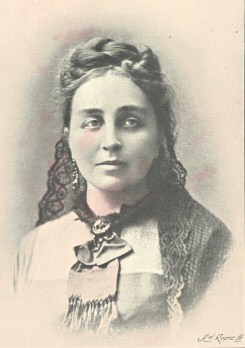
The lady who inspired both the eulogy and the curtailment wasMadame Novikoff, more widely known perhaps as O. K., with whomKinglake maintained during the last twenty years of life anintimate and mutual friendship. Madame Olga Novikoff,néeKiréeff, is a Russian lady ofaristocratic rank both by parentage and marriage. In alengthened sojourn at Vienna with her brother-in-law, the Russianambassador, she learned the current business of diplomacy. An eager religious propagandist, she formed alliance with the“Old Catholics” on the Continent, and with many amongthe High Church English clergy; becoming, together with herbrother Alexander, a member of the RéunionNationale, a society for the union of Christendom. Herinterest in p.93education has led her to devote extensive help to schooland church building and endowment on her son’sestate. God-daughter to the Czar Nicholas, she is a devotedImperialist, nor less in sympathy, as were all her family, withRussian patriotism: after the death of her brother in Servia onJuly 6/18, 1876, she became a still more ardent Slavophile. The three articles of her creed are, she says, those of hercountry, Orthodoxy, Autocracy, Nationalism. Her politicalaspirations have been guided, and guided right, by her tact andgoodness of heart. Her life’s aim has been to bringabout a cordial understanding between England and her nativeland; there is little doubt that her influence with leadingLiberal politicians, and her vigorous allocutions in the Press,had much to do with the enthusiasm manifested by England for theliberation of the Danubian States. Readers of the PrincessLieven’s letters to Earl Grey will recall the part playedby that able ambassadress in keeping this country neutral throughthe crisis of 1828–9; to her Madame Novikoff has beenlikened, and probably with truth, by the Turkish Press bothEnglish and Continental. She was accused in 1876 of playingon the p.94religious side of Mr. Gladstone’s character tosecure his interest in the Danubians as members of the GreekChurch, while with unecclesiastical people she was said to beequally skilful on the political side, converting at the sametime Anglophobe Russia by her letters in the “MoscowGazette.” Mr. Gladstone’s leanings toMontenegro were attributed angrily in the English“Standard” to Madame Novikoff: “A seriousstatesman should know better than to catch contagion from thepetulant enthusiasm of a Russian Apostle.” Thecontagion was in any case caught, and to some purpose; letterafter letter had been sent by the lady to the great statesman,then in temporary retirement, without reply, until the last ofthese, “a bitter cry of a sister for a sacrificedbrother,” brought a feeling answer from Mrs. Gladstone,saying that her husband was deeply moved by the appeal, and waswriting on the subject. In a few days appeared his famouspamphlet, “Bulgarian Horrors and the Question of theEast.”
Carlyle advised that Madame Novikoff’s scattered papersshould be worked into a volume; they appeared under the title“Is Russia Wrong?” with a preface by Froude, p. 95the moderateand ultra-prudent tone of which infuriated Hayward and Kinglake,as not being sufficiently appreciative. Hayward declaredsome woman had biassed him; Kinglake was of opinion that bystudying the ètatof Queen Elizabeth Froude had“gone and turned himself into an old maid.”
Froude’s Preface to her next work, “Russia andEngland, a Protest and an Appeal,” by O. K., 1880, wasworded in a very different tone and satisfied all herfriends. The book was also reviewed with highest praise byGladstone in “The Nineteenth Century.” Learningthat an assault upon it was contemplated in “TheQuarterly,” Kinglake offered to supply the editor, Dr.Smith, with materials which might be so used as to neutralize apersonalattack upon O. K. Smith entreated him tocompose the whole article himself. “I could promiseyou,” he writes, “that the authorship should be kepta profound secret;” but this Kinglake seems to have thoughtundesirable. The article appeared in April, 1880, under thetitle of “The Slavonic Menace to Europe.” Itopens with a panegyric on the authoress: “She has masteredour language with conspicuous success; she expostulates as easilyas she reproaches, and she p. 96exhibits as much facility in barbingshafts of satire as in framing specious excuses for daring actsof diplomacy.” It insists on the high esteem felt forher by both the Russian and Austrian governments, telling withmuch humour an anecdote of Count Beust, the Prime Minister ofAustria during her residence in Vienna. The Count, aftermeeting her at a dinner party at the Turkish Embassy, composed aset of verses in her honour, and gave them to her, but she forgotto mention them to her brother-in-law. The Prime Minister,encountering the latter, asked his opinion of the verses; and theambassador was greatly amazed at knowing nothing of the matter.[96] From amenities towards theauthoress, the article passes abruptly to hostile criticism ofthe book; declares it to be proscribed in Russia as mischievous,and to have precipitated a general war by keeping up Englishinterest in p.97Servian rebellion. It sneers in doubtful taste atthe lady’s learning:
“sitnon doctissima conjux,
Sit nox cum somno, sit sine lite dies;”
denounces the Slavs as incapable of being welded into anation, urging that their independence must destroyAustria-Hungary, a consummation desired by Madame Novikoff, withher feline contempt for “poor dear Austria,” butwhich all must unite to prevent if they would avert a Europeanwar.
How could one clear harp, men asked themselves as they read,have produced so diverse tones? The riddle is solved whenwe learn that the first part only was from Kinglake’s pen:having vindicated his friend’s ability and good faith, herright to speak and to be heard attentively, he left the survey ofher views, with which he probably disagreed, to the originallyassigned reviewer. The article, Madame Novikoff tells us inthe “Nouvelle Revue,” was received avec unestupefaction unanime. It formed the general talk formany days, was attributed to Lord Salisbury, was supposed to havebeen inspired by Prince Gortschakoff. The name standingagainst it in Messrs. Murray’s books, as they p. 98kindly informme, is that of a writer still alive, and better known now thanthen, but they never heard that Kinglake had a hand in it; theeditor would seem to have kept his secret even from thepublishers. Kinglake sent the article in proof to the lady;hoped that the facts he had imparted and the interpolations hehad inserted would please her; he could have made the attack onRussia more pointed had he written it; she would think theleniency shows a fault on the right side; he did not know thewriter of this latter part. He begged her to acquaint herfriends in Moscow what an important and majestic organ is“The Quarterly,” how weighty therefore its laudationof herself. She recalls his bringing her soon afterwards anarticle on her, written, he said, in an adoring tone by Laveleyein the “Revue des Deux Mondes,” and directing her toa paper in “Fraser,” by Miss Pauline Irby, apassionate lover of the “Slav ragamuffins,” and aworshipper of Madame Novikoff. He quotes with delightChenery’s approbation of her “Life ofSkobeleff”; he spoke of you “with a gleam ofkindliness in his eyes which really and truly I had neverobserved before.” “The Times” quotes heras the “eloquent p. 99authoress of ‘Russia andEngland’”; “fancy that from your enemy! you aregetting even ‘The Times’ into your net.” A later article on O. K. contains some praise, but moreabuse. Hayward is angry with it; Kinglake thinks it morefriendly than could have been expected “to you, afriend of me, their old open enemy: the sugar-plums weremeant for you, the sprinklings of soot for me.”
Besides “Russia and England” Madame Novikoff isthe author of “Friends or Foes?—is Russiawrong?” and of a “Life of Skobeleff,” the heroof Plevna and of Geok Tepé. From her naturalendowments and her long familiarity with Courts, she has acquireda capacity for combining, controlling, entertaining social“circles” which recalls les salonsd’autrefois, the drawing-rooms of an Ancelot, a LeBrun, a Récamier. Residing in several Europeancapitals, she surrounds herself in each with personsintellectually eminent; in England, where she has long spent herwinters, Gladstone, Carlyle and Froude, Charles Villiers, BernalOsborne, Sir Robert Morier, Lord Houghton, and many more of thesame high type, formed her court and owned her influence.
Kinglake first met her at Lady Holland’s in p. 1001870, andmutual liking ripened rapidly into close friendship. Duringher residences in England few days passed in which he did notpresent himself at her drawing-room in Claridge’s Hotel:when absent in Russia or on the Continent, she received from himweekly letters, though he used to complain that writing to a ladythrough the poste restantewas like trying to kiss a nunthrough a double grating. These letters, all faithfullypreserved, I have been privileged to see; they remind me, intheir mixture of personal with narrative charm, of Swift’s“Letters to Stella”; except that Swift’s areoften coarse and sometimes prurient, while Kinglake’schivalrous admiration for his friend, though veiled occasionallyby graceful banter, is always respectful and refined. Theyeven imitate occasionally the “little language” ofthe great satirist; if Swift was Presto, Kinglake is “Poordear me”; if Stella was M. D., Madame Novikoff is “Mydear Miss.” This last endearment was due to anincident at a London dinner table. A story told by Hayward,seasoned as usual with gros sel, amused the moresophisticated English ladies present, but covered her withblushes. Kinglake perceived it, and said to her afterwards,“I thought p.101you were a hardened married woman; I am glad that youare not; I shall henceforth call you Miss.” Sometimes he rushes into verse. In answer to some pretendedrebuff received from her at Ryde he writes
“There was a young lady of Ryde, so awfullypuffed up by pride,
She felt grander by far than the Son of the Czar,
And when he said, ‘Dear, come and walk on the pier,
Oh please come and walk by my side;’
The answer he got, was ‘Much better not,’ from thatawful young lady of Ryde.”
Oftenest, the letters are serious in their admiringcompliments; they speak of her superb organization of health andlife and strength and joyousness, the delightful sunshine of herpresence, her decision and strength of will, her great qualitiesand great opportunities: “away from you the world seems ablank.” He is glad that his Great Eltchi has beenmade known to her; the old statesman will be impressed, he feelssure, by her “intense life, graciousness and grace,intellect carefully masked, musical faculty in talk, with thatheavenly power of coming to an end.” He sendsplayfully affectionate messages from other members of theGerontaion, as he calls it, the group of aged admirers whop. 102formedher inner court; echoing their laments over the universality ofher patronage. “Hayward can pardon your having anambassador or two at your feet, but to find the way toyour heartobstructed by a crowd of astronomers,Russ-expansionists, metaphysicians, theologians, translators,historians, poets;—this is more than he can endure. The crowd reduces him, as Ampère said to Mme.Récamier, to the qualified blessing of being only chezvous, from the delight of being avecvous.” He hails and notifies additions to thelist of her admirers; quotes enthusiastic praise of her fromStansfeld and Charles Villiers, warm appreciation from Morier,Sir Robert Peel, Violet Fane. He rallies her on hervictims, jests at Froude’s lover-likegalanterie—“Poor St. Anthony! how he hoveredround the flame”;—at the devotion of that gayLothario, Tyndall, whose approaching marriage will, he thinks,clip his wings for flirtation. “It seems that at theRoyal Institution, or whatever the place is called, young womenlook up to the Lecturers as priests of Science, and go to themafter the lecture in what churchmen would call the vestry, andexpress charming little doubts about electricity, and prettygentle disquietudes about the solar p. 103system: and then the Professors haveto give explanations;—and then, somehow, at the end of afew weeks, they find they have provided themselves with chaperonsfor life.” So he pursues the list of devotees; herson will tell her that Cæsar summarized his conquests inthis country by saying Veni, Vidi, Vici; butto her it is given to say, Veni, Videbar,Vici.
On two subjects, theology and politics, Madame Novikoff was,as we have seen, passionately in earnest. Himself at oncean amateur casuist and a consistent Nothingarian, whose dictumwas that “Important if true” should be written overthe doors of churches, he followed her religious arguments muchas Lord Steyne listened to the contests between Father Mole andthe Reverend Mr. Trail. He expresses his surprise in allseriousness that the Pharisees, a thoughtful and cultured set ofmen, who alone among the Jews believed in a future state, shouldhave been the very men to whom our Saviour was habituallyantagonistic. He refers more lightly and frequently to“those charming talks of ours about our Churches”; hethinks they both know how to effleurerthe surface oftheology without p.104getting drowned in it. Of existing Churches hepreferred the English, as “the most harmless going”;disliked the Latin Church, especially when intriguing in theEast, as persecuting and as schismatic, and therefore as noChurch at all. Roman Catholics, he said, have a specialhorror of being called “schismatic,” and that is, ofcourse, a good reason for so calling them. He would notpermit the use of the word “orthodox,” because, likea parson in the pulpit, it is always begging the question. He refused historical reverence to the Athanasian Creed, and wasdelighted when Stanley’s review in “The Times”of Mr. Ffoulkes’ learned book showed it to have beenwritten by order of Charles the Great in 800 A.D. as what Thorold Rogers used to call“an election squib.” In the“Filioque” controversy, once dear to Liddon and toGladstone, now, I suppose, obsolete for the English mind, butwhich relates to the chief dividing tenet of East from West, heshowed an interest humorous rather than reverent; took pains toacquaint himself with the views held on it by Döllinger andthe old Catholics; noted with amusement the perplexity of Londonladies as to the meaning of the word when quoted in the much-read“Quarterly” article, declaring their p. 105belief tobe that it was a clergyman’s baby born out of wedlock.
Madame Novikoff’s political influence, which herecognized to the full, he treated in the same mockingspirit. She is at Berlin, received by Bismarck; he hopesthat though the great man may not eradicate her Slavophileheresies, he may manifest the weakness of embroiling nations onmere ethnological grounds. “Are even nearerrelationships so delightful? would you walk across the street fora third or fourth cousin? then why for a millionthcousin?” Madame Novikoff kindly sends to me an“Imaginary Conversation” between herself andGortschakoff, constructed by Kinglake during her stay in St.Petersburg in 1879.
“G. Well—you really have done goodservice to your country and your Czar by dividing and confusingthese absurd English, and getting us out of the scrape we were inin that—Balkan Peninsula.
“Miss O. Well, certainly I did my best; butI fear I have ruined the political reputation of my Englishpartizans, for in order to make them ‘beloved of theSlave,’ I of course had to make them, poor souls! goagainst their own country; p. 106and their country, stupid as it is,has now I fear found them out.
“G. Tant pis pour eux! Entre nous, if I had been Gladstone, I should havepreferred the love of my own country to the love ofthese—Slaves of yours. But, tell me, how did you gethold of Gladstone?
“Miss O. Rien de plus simple! Four or five years ago I asked what was his weak point, and wastold that he had two, ‘Effervescence,’ and‘Theology.’ With that knowledge I found it allchild’s play to manage him. I just sent him toMunich, and there boiled him up in a weak decoction of‘Filioque,’ then kept him ready for use, andimpatiently awaited the moment when our plans for getting up the‘Bulgarian atrocities’ should be mature. I say‘impatiently,’ for, Heavens, how slow you all were!at least so it strikes a woman. The arrangement of the‘atrocities’ was begun by our people in 1871, and yettill 1876, though I had Gladstone ready in 1875, nothing reallywas done! I assure you, Prince, it is a trying thing to awoman to be kept waiting for promised atrocities such anunconscionable time.
“G. That brother-in-law of yours was partlythe cause of our slowness. He was always p. 107wanting tohave the orders for fire and blood in neat formal despatches,signed by me, and copied by clerks. However, I hope you aresatisfied now, with the butcheries and the flames, and the—?
“Miss O. Pour le moment!”
She is absent during the sudden dissolution of Parliament in1874. “London woke yesterday morning and found thatyour friend Gladstone had made acoup-d’état. He has dissolvedParliament at a moment when no human being expected it, and myimpression is that he has made a good hit, and that the renovatedParliament will give him a great majority.” The impressionwas wildly wrong; and he found a cause for the Conservativemajority in Gladstone’s tame foreign policy, and especiallyin the pusillanimity his government showed when insulted byGortschakoff. He always does justice to her influence withGladstone; his great majority at the polls in 1880 is hervictory and hertriumph; but his Turkophobia is no lessher creation: “England is stricken with incapacity becauseyou have stirred up the seething caldron that boils underGladstone’s skull, putting in diabolical charms and poisonsof theology to overturn the structure of English p.108polity:” she will be able, he thinks, to tell hergovernment that Gladstone is doing his best to break up theBritish Empire.
He quotes with approbation the newspaper comparison of her tothe Princess Lieven. She disparages the famousambassadress; he sets her right. Let her read the“Correspondence,” by his friend Mr. Guy Le Strange,and she will see how large a part the Princess played in keepingEngland quiet during the war of 1828–29. She did notconvert her austere admirer, Lord Grey, to approval of theRussian designs, nor overcome the uneasiness with which the Dukeof Wellington regarded her intrigues; but the Foreign Minister,Lord Aberdeen, was apparently a fool in her hands; and, whoeverhad the merit, the neutrality of England continued. Thatwas, he repeats more than once, a most critical time for Russia;it was an object almost of life and death to the Czar to keepEngland dawdling in a state of actual though not avowedneutrality. It is, he argued, a matter of fact, thatprecisely this result was attained, and “I shall be slow tobelieve that Madame de Lieven did not deserve a great share ofthe glory (as you would think it) of making England act weaklyunder such p.109circumstances; more especially since we know that theDuke did not like the great lady, and may be supposed to havedistinctly traced his painful embarrassment to herpower.” So the letters go, interspersed with news,with criticisms of notable persons, with comments enlightening orcynical on passing political events: with personal matters onlynow and then; as when he notes the loss of his two sisters;dwells with unwonted feeling on the death of his eldest nephew byconsumption; condoles with her on her husband’s illness;gives council, wise or playful, as to the education of herson. “I am glad to hear that he is good at Greek,Latin, and Mathematics, for that shows his cleverness; glad alsoto hear that he is occasionally naughty, for that shows hisforce. I advise you to claim and exercise as much controlas possible, because I am certain that a woman—especiallyso gifted a one as you—knows more, or rather feels more,about the right way of bringing up a boy than any mereman.”
Unbrokenly the correspondence continues: the intimacy addedcharm, interest, fragrance to his life, brought out in him allthat was genial, playful, humorous. He fights theadmonitions p.110of coming weakness; goes to Sidmouth with a sorethroat, but takes his papers and his books. It is, he says,a deserted little sea-coast place. “Mrs. Grundy has asmall house there, but she does not know me by sight. IfMadame Novikoff were to come, the astonished little town, dazzledfirst by her, would find itself invaded by theologians, bishops,ambassadors of deceased emperors, and anex-Prime-Minister.” But as time goes on he speaksmore often of his suffering throat; of gout, increasing deafness,only half a voice: his last letter is written in July, 1890, tocondole with his friend upon her husband’s death. InOctober his nurse takes the pen; Madame Novikoff comes backhurriedly from Scotland to find him in his last illness. “It is very nice,” he told his nurse, “to seedear Madame Novikoff again, but I am going down hill fast, andcannot hope to be well enough to see much of her.” This is in November, 1890; on New Year’s Eve came theinexorable, “Terminator of delights and Separator offriends.”
p.111CHAPTER VI
LATER DAYS, AND DEATH
For twenty years Kinglake lived inHyde Park Place, in bright cheerful rooms looking in onedirection across the Park, but on another side into achurchyard. The churchyard, Lady Gregory tells us, gave himpause on first seeing the rooms. “I should not liketo live here, I should be afraid of ghosts.” “Oh no, sir, there is always a policeman round thecorner.” [111] “Pleaceman X.” hasnot, perhaps, before been revered as the Shade-compelling son ofMaia:
“Tu pias lætis animas reponis
Sedibus, virgaque levem coerces
Aurea turbam.”
Here he worked through the morning; the afternoon took him tothe “Travellers,” where his friends, Sir HenryBunbury and Mr. Chenery, usually expected him; then at eight p.112o’clock, if not, as Shylock says, bid forth, hewent to dine at the Athenæum. His dinner seat was inthe left-hand corner of the coffee-room, where, in the thirties,Theodore Hook had been wont to sit, gathering near him so manylisteners to his talk, that at Hook’s death in 1841 thereceipts for the club dinners fell off to a large amount. Here, in the “Corner,” as they called it, roundKinglake would be Hayward, Drummond Wolff, Massey, Oliphant,Edward Twisleton, Strzelecki, Storks, Venables, Wyke, Bunbury,Gregory, American Ticknor, and a few more; Sir W. StirlingMaxwell, when in Scotland, sending hampers of pheasants to thecompany. “Hurried to the Athenæum fordinner,” says Ticknor in 1857, “and there foundKinglake and Sir Henry Rawlinson, to whom were soon added Haywardand Stirling. We pushed our tables together and had a jollydinner. . . . To the Athenæum; and having dined pleasantlywith Merivale, Kinglake, and Stirling, I hurried off to theHouse.” In later years, when his voice grew low andhis hearing difficult, he preferred that the diners shouldresolve themselves into little groups, assigning to himself atête-à-tête, with whom at his ease hecould unfold himself.
p. 113Noman ever fought more gallantly the encroachments of oldage—on sut être jeune jusque dans ses vieuxjours. At seventy-four years old, staying with a friendat Brighton, he insisted on riding over to Rottingdean, where SirFrederick Pollock was staying. “I mastered,” hesaid, in answer to remonstrances, “I mastered thepeculiarities of the Brighton screw before you were born, andhave never forgotten them.” Vaulting into his saddlehe rode off, returning with a schoolboy’s delight at thebrisk trot he had found practicable when once clear of theKing’s Road. Long after his hearing had failed, hissight become grievously weakened, and his limbs not alwaystrustworthy, he would never allow a cab to be summoned for himafter dinner, always walking to his lodgings. But he had togive up by and by his daily canter in Rotten Row, and morereluctantly still his continental travel. Foreign railwayswere closed to him by the Salle d’Attente; he couldnot stand incarceration in the waiting-rooms.
The last time he crossed the Channel was at the close of theFranco-Prussian war, on a visit to his old friend M. Thiers, thenPresident. It was a dinner to deputies of the Extreme Left,and Kinglake was the only Englishman; “so,” he p. 114said,“among the servants there was a sort of reasoning processas to my identity, ending in the conclusion, ‘il doitêtre Sir Dilke.’” Soon the inferencewas treated as a fact; and in due sequence came newspaperparagraphs declaring that the British Ambassador had gravelyremonstrated with the President for inviting Sir Charles Dilke tohis table. Then followed articles defending the coursetaken by the President, and so for some time the ball was keptup. The remonstrance of the Ambassador was a myth, LordLyons was a friend of Sir Charles; but the latter was suspect atthe time both in England and France; in England for his speechesand motion on the Civil List; in France, because, with FredericHarrison, he had helped to get some of the French Communists awayfrom France; and the French Government was watching him withspies. In Sir Charles’s motion Kinglake took muchinterest, refusing to join in the cry against it asdisloyal. Sir Charles, he said, spoke no word against theQueen; and only brought the matter before the House becausechallenged to repeat in Parliament the statements he had made inthe country. As a matter of policy he thought it mistaken:“Move in such a matter p. 115openly, and party discipline compelsyour defeat; bring pressure to bear on a Cabinet, some of itsmembers are on your side, and you may gain yourpoint.” Sir Charles’s speech was calmlyargumentative, and to many minds convincing; it provoked apassionate reply from Gladstone; and when Mr. Auberon Herbertfollowing declared himself a Republican, a tumult arose such asin those pre-Milesian days had rarely been witnessed in theHouse. But the wisdom of Kinglake’s counsel issustained by the fact that many years afterwards, as a result ofmore private discussion, Mr. Gladstone pronounced his conversionto the two bases of the motion, publicity, and the giving of theState allowance to the head of the family rather than, person byperson, to the children and grandchildren of the Sovereign. Action pointing in this direction was taken in 1889 and 1901 onthe advice of Tory ministers.
Amongst Frenchmen of the highest class, intellectually andsocially, he had many valued friends, keeping his name on the“Cosmopolitan” long after he had ceased to visit it,since “one never knows when the distinguished foreigner maycome upon one, and of such the p. 116Cosmo is the LondonParadise.” But he used to say that in the other worlda good Frenchman becomes an Englishman, a bad Englishman becomesa Frenchman. He saw in the typical Gaul a compound of thetiger and the monkey; noted their want of individuality, theirtendency to go in flocks, their susceptibility to panic and toferocity, to the terror that makes a man kill people, and“the terror that makes him lie down and beg.” We remember, too, his dissection of St. Arnaud, as before allthings a type of his nation; “he impersonated with singularexactness the idea which our forefathers had in their minds whenthey spoke of what they called ‘a Frenchman;’ foralthough (by cowing the rich and by filling the poor with envy),the great French Revolution had thrown a lasting gloom on thenational character, it left this one man untouched. He wasbold, gay, reckless, vain; but beneath the mere glitter of thesurface there was a great capacity for administrative business,and a more than common willingness to take away humanlife.”
“I relish,” Kinglake said in 1871, “thespectacle of Bismarck teaching the A B C of Liberal politics tothe hapless French. His p. 117last mot, they tell me, isthis. Speaking of the extent to which the French Emperorhad destroyed his own reputation and put an end to the worship ofthe old Napoleon, he said: ‘He has killed himself andburied his uncle.’” Again, in 1874, noting thecontre coupupon France resulting from the Bismarck andArnim despatches, he said: “What puzzles the poor dearFrench is to see that truth and intrepid frankness consist withsound policy and consummate wisdom. How funny it would be,if the French some day, as a novelty, or what they would call acaprice, were to try the effect of truth; “thoughnot naturally honest,” as Autolycus says, “were tobecome so by chance.”
He thought M. Gallifet dans sa logiquein liking theGermans and hating Bismarck; for the Germans, in having their ownway, would break up into as many fragments as the best Frenchmancould desire, and Bismarck is the real suppressor ofFrance. Throughout the Franco-Prussian war he sidedstrongly with the Prussians, refusing to dine in houses where theprevailing sympathy with France would make him unwelcome as itsdeclared opponent; but he felt “as a nightmare” theattack on prostrate Paris, “as a blow” thecapitulation p.118of Metz; denouncing Gambetta and his colleagues asmeeting their disasters only with slanderous shrieks,“possessed by the spirit of that awful Popishwoman.” Bismarck as a statesman he consistentlyadmired, and deplored his dismissal. I see, he said, allthe peril implied by Bismarck’s exit, and the advent of hisambitious young Emperor. It is a transition from the knownto the unknown, from wisdom, perhaps, to folly.
His Crimean volumes continued to appear; in 1875, 1880,finally in 1887; while the Cabinet Edition was published in1887–8. This last contained three new Prefaces; inVol. I. as we have seen, the memorial of Nicholas Kiréeff;in Vol. II. the latter half of the original Preface to Vol. I.,cancelled thence at Madame Novikoff’s request, though nowcarefully modified so as to avoid anything which might irritateRussia at a moment when troubles seemed to be clearingaway. In his Preface to Vol. VII. he had three objects, toset right the position of Sir E. Hamley, who had been neglectedin the despatches; to demolish his friend Lord Bury, who had“questioned my omniscience” in the “EdinburghReview”; and to exonerate England at large from absurdself-congratulations about p. 119the “little Egyptaffair,” the blame of such exaggeration resting with thosewhom he called State Showmen.
Silent to acquaintances about the progress of his work, he wascommunicative to his few intimates, though never reading aloudextracts or allowing them to be seen. In 1872 he wouldspeak pathetically of his “Crimean muddle,”perplexed, as he well might be, by the intricacies ofInkerman. Asked if he will not introduce a Te Deum on thefall of Louis Napoleon, he answered that to write without thestimulus of combat would be a task beyond his energy; “whenI took the trouble to compose that fourteenth chapter, thewretched Emperor and his gang were at the height of their powerin Europe and the world; but now!” He was insatiate as tofresh facts: utilized his acquaintance with Todleben, whom he hadfirst met on his visit to England in 1864; sought out PrinceOurusoff at a later time, and inserted particulars gleaned fromhim in Vol. IX., Chapter V.
In 1875 he told Madame Novikoff that his task was done so faras Inkerman was concerned, and was proud to think that he hadrescued from oblivion the heroism of the Russian troops in whathe calls the “Third Period” p. 120of thegreat fight, ignored as it was by all Russian historians of thewar. He made fruitless inquiries after a paper said to havebeen left behind him by Skobeleff, explaining that “Indiais a cherry to be eaten by Russia, but in two bites”; itwas contrary to the general’s recorded utterances andprobably apocryphal. Russophobe as regarded Turkey, hesneered at England’s sentimental support of nationalitiesas “Platonic”: a capital epithet he called it, andenvied the Frenchman who applied it to us, declaring that it hadturned all the women against us. He was moved by receivingKorniloff’s portrait with a kind message from the deadhero’s family, seeing in the features a confirmation of theideal which he had formed in his own mind and had tried to conveyto others. Readers of his book will recall the fine tributeto Korniloff’s powers, and the description of his death, inChapters VI. and XIII. of Vol. IV. (Cabinet Edition).
Many of his comments on current events are preserved in thenotes or in the memories of his friends. Sometimes thesewere characteristically cynical. He ridiculed the newspaperparade of national sympathy with the Prince of Wales’sillness: “We are represented as all members of p. 121the royalfamily, and all in family hysterics.” Dizzy’sorientalization of Queen Victoria into an Empress angered him, asit angered many more. The last Empress Regnant, he said,was Catherine II. and it seems to be thought that by advising theQueen to take that great monarch’s title, we shall exercisea wholesome influence on the morals of our women. He wouldquote Byron’s
“Russia’smighty Empress
Behaved no better than a common sempstress;”
“there was an old-fashioned sacredness, which, howeverfoolish intrinsically, was still useful, in our title of‘The Queen’; nor do we see the policy of adding aSuprême de Volailleto the bread and wine of ourSacrament.”
He chuckled over the indignation of the hautevolée, when on the visit to England of PresidentGrant’s daughter in 1872, Americans in London sent outcards of invitation headed “To meet Miss Grant,” asat a profane imitation of a practice hitherto confined toroyalties; laughing not at the legitimate American mimicry ofEuropean consequence, but at the silly formalists in Society whofumed over the imagined presumption. Consulted by aninvalid as to the p.122charm of Ostend for a seaside residence, he limited itto persons of gregarious habits; “the people are all drivendown to the beach like a flock of sheep in the morning, and inthe evening they are all driven back to their folds.” He reported a feeble drama written by his ancient idol, LordStratford de Redcliffe; “it is a painful thing to see a manof his quality and of his age unduly detained in the world; whenthe Emperor Nicholas died, the Eltchi lost his raisond’être.” He disparaged the wild fitof morality undergone by the “Pall Mall Gazette”during the scandalous “Maiden Tribute” revelation,pronouncing its protegées to be “clever littledevils.” He was greatly startled byGortschakoff’s famous circular, annulling the Black Seaclause in the Treaty of Paris, and much relieved byBismarck’s dexterous interposition, which saved thesusceptibility of Europe, and especially of England, by yieldingas a favour to the demand of Russia what no one was in a positionto refuse; but he maintained, and Lord Stratford agreed with him,that Gortschakoff’s precipitate act was governed bycircumstances never revealed to mankind. He learned, too,that it caused the Chancellor to bedéconsideréin high Russian circles; he wascalled p.123“un Narcisse qui se mire dans sonencrier.” Kinglake used to say that in concedingthe right of the Sultan to exclude any war-flag from theBosphorus and the Dardanelles, Russia was treating Turkey as abag-fox, to be gently hunted occasionally, but not mangled orkilled; and he felt keenly the ridicule resting on the allies,who were compelled to surrender the neutralization purchased atthe cost of so much blood and treasure. He watched withmuch amusement the restoration of Turkish self-confidence. “Turkey believes that he is no longer a sick man, and isturning all his doctors out of the house, to the immenseastonishment of the English doctor, so conscious of his ownrectitude that he cannot understand being sent off with thequacks. You know in our beautiful Liturgy we have a prayerfor the Turks; it looks as if our supplications had becomesuccessful.” His interest in Turkey neverflagged. “I am in a great fright,” he said in1877, “about my dear Turks, because Russia gives virtualcommand of the army before Plevna to Todleben, a really greathomme de guerre.”
Russophobia was at that time so strong in London that MadameNovikoff hesitated to visit England, and he himself feared thatshe p.124might find it uncomfortable. Her alarm, however,was ridiculed by Hayward, “most faithful of theRussianisers, ready to do battle for Russia at any moment,declaring her to be quite virtuous, with no fault but that ofbeing incomprise.” But he groaned over thehumiliation of England under Russia’s bold stroke, notingfrequently a decay of English character which he ascribed tochronic causes. The Englishman taken separately, he said,seems much the same as he used to be; but there is a softening ofthe aggregate brain which affects Englishmen when actingtogether. He hailed the great Liberal victory of 1880, andwatched with interest, as one behind the scenes, the negotiationswhich led to Lord Hartington’s withdrawal and Mr.Gladstone’s resumption of power; for in these his friendHayward was an active go-between, removing by his tact andfrankness “hitches” which might otherwise have beendisastrous. He thought W. E. Forster’s attack on Mr.Gladstone’s Irish policy in 1882 ill-managed for his ownposition, his famous speech not sufficiently“clenching.” Had he separated from his chief onbroader grounds, refusing complicity with a Minister whoconsented to parley with the imprisoned Irishmen, p. 125he would,Kinglake thought, have occupied a highly commandingposition. At present his difference from his colleagues wasone only of degree.
He was once beguiled, amongst friends very intimate, intotelling a dream. He dreamed that he was attending ananatomical lecture—which, as a fact, he had neverdone—and that his own body, from which he found himselfentirely separated, was the dissected subject on which thelecturer discoursed. The body lay on a table beside thelecturer, but he himself, his entity, was at the other end of theroom, on the furthest or highest of a set of benches raised oneabove the other as at a theatre. He imagined himself in avague way to be disagreeing with the lecturer; but the strongestimpression on his mind was annoyance at being so badly placed, sofar from the professor and from his own body that he could notsee or hear without an effort. The dream, he pointed out,showed this curious fact, that without any conscious design oreffort of the will a man may conceive himself to be in perfectpossession of his identity, whilst separated from his own body bya distance of several feet. “The highestconcept,” said Jowett, “which man forms of himself isas p.126detached from the body.” (“Life,” ii. 241.) The lecture-room which heimagined was one of the lower school-rooms at Eton, with which hehad been familiar in early days.
After Hayward’s death in 1884, his own habits began tochange. He still dined at the Athenæum“corner,” but increasing deafness began to makesociety irksome, and, his solitary meal ended, he spent hisevenings reading in the Library. By-and-by that too becameimpossible. His voice grew weak, throat and tongue werethreatened with disease. In 1888 he went to Brighton with anurse, returned to rooms on Richmond Hill, then to BayswaterTerrace. An operation was performed and he seemed torecover, but relapsed. Old friends tended him: MadameNovikoff, Mr. Froude and Mr. Lecky, Madame de Quaire and Mrs.Brookfield, Lord Mexborough his ancient fellow-traveller, Mrs.Craven, Sir William and Lady Gregory, with a few more, cheeredhim by their visits so long as he was able to bear them; and hisbrother and sister, Dr. and Mrs. Hamilton Kinglake, were with himat the end. Patient to the last, kind and gentle to allabout him, he passed away quietly on New Year’s Day,1891:
p.127“being merry-hearted,
Shook hands with flesh and blood, and so departed.”
His remains were cremated at Woking, after a special serviceat Christchurch, Lancaster Gate, attended by Dr. and Mrs.Kinglake with their son Captain Kinglake, the Duke of Bedford,Mr. and Mrs. Lecky, Mrs. W. H. Brookfield and her sonCharles.
No good portrait of him has been published. Thatprefixed to Blackwood’s “Eothen” of 1896 wasfurnished by Dr. Kinglake, who, however, looked upon it asunsatisfactory. The “Not an M.P.” of“Vanity Fair,” 1872, is a grotesque caricature. The photograph here reproduced (p. 128), by far the best likenessextant, he gave to Madame Novikoff in 1870, receiving hers inreturn, but pronouncing the transaction “an exchangebetween the personified months of May and November.” The face gives expression to the shy aloofness which, amongststrangers, was characteristic of him through life. He hadeven a horror of hearing his name pealed out by servants, andcame early to parties that the proclamation might be achievedbefore as few auditors as possible. Visiting the newlymarried husband of his p. 128friend Adelaide Kemble, and beingthe first guest to arrive, he encountered in Mr. Sartoris a hostas contentedly undemonstrative as himself. Bows passed, aseat by the fire was indicated, he sat down, and the paircontemplated one another for ten minutes in absolute silence,till the lady of the house came in, like the prince in “TheSleeping Beauty,” though not by the same process, to breakthe charm. He gave up calling at a house where he waswarmly appreciated, because father, mother, daughter, bombardedhim with questions. “I never came away withoutfeeling sure that I had in some way perjured myself.”
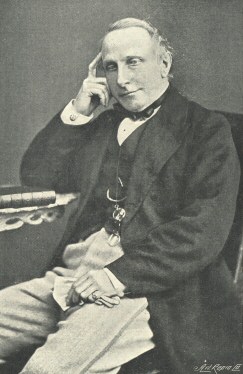
On his shyness waited swiftly ensuing boredom; if hisneighbour at table were garrulous or banale, his face atonce betrayed conversational prostration; a lady who oftenwatched him used to say that his pulse ought to be felt after thefirst course; and that if it showed languor he should be moved tothe side of some other partner. “He had greatcharm,” writes to me another old friend, “in a quietwinning way, but was ‘dark’ with rough and noisypeople.” So it came to pass that his manner wasthreefold; icy and repellent with those who set his nerves onedge; good-humoured, receptive, intermittently responsive p. 129in generaland congenial company; while, at ease with friends trusted andbeloved, the lines of the face became gracious, indulgent,affectionate, the sourire des yeuxoften inexpressiblywinning and tender. “Kinglake,” says EliotWarburton in his unpublished diary, “talked to us to-dayabout his travels; pessimistic and cynical to the rest of theworld, he is always gentle and kind to us.” To thisdear friend he was ever faithful, wearing to the day of his deathan octagonal gold ring engraved “Eliot. Jan:1852.” He would never play the raconteuringeneral company, for he had a great horror of repeating himself,and, latterly, of being looked upon as a bore by younger men; buthe loved to pour out reminiscences of the past to an audience ofone or two at most: “Let an old man gather hisrecollections and glance at them under the right angle, and hislife is full of pantomime transformation scenes.” Thechief characteristic of his wit was its unexpectedness; sometimesacrid, sometimes humorous, his sayings came forth, like TophamBeauclerk’s in Dr. Johnson’s day, likeTalleyrand’s in our own, poignant without effort. Hiscalm, gentle voice, contrasted with his startling causticutterance, reminded people of Prosper p. 130Mérimée: terseepigram, felicitous apropos, whimsical presentment of thetopic under discussion, emitted in a low tone, and without theslightest change of muscle:
“All the charm of all the Muses
Often flowering in a lonely word.” [130]
Questions he would suavely and often wittily parry or repel:to an unhistorical lady asking if he remembered Madame Du Barry,he said, “my memory is very imperfect as to the particularsof my life during the reign of Lous XV. and the Regency; but Iknow a lady who has a teapot which belonged, she says, to MadameDu Barry.” Madame Novikoff, however, records hisdiscomfiture at the query of a certain Lady E—, who, whenall London was ringing with his first Crimean volumes, asked himif he were not an admirer of Louis Napoleon. “Lepauvre Kinglake, décontenancé, repondit toutbas intimidé comme un enfant qu’on met dates lecoin: Oui—non—pasprécisément.”
He had no knowledge of or liking for music. Present onceby some mischance at a matinée p.131musicale, he was asked by the hostess what kindof music he preferred. His preference, he owned, was forthe drum. One thinks of the “BourgeoisGentilhomme,” “la trompette marine est uninstrument qui me plait, el qui est harmonieux”; we arereminded, too, of Dean Stanley, who, absolutely tone-deaf, andhurrying away whenever music was performed, once from anadjoining room in his father’s house heard Jenny Lind sing“I know that my Redeemer liveth.” He went toher shyly, and told her that she had given him an idea of whatpeople mean by music. Once before, he said in allseriousness, the same feeling had come over him, when before thepalace at Vienna he had heard a tattoo rendered by four hundreddrummers.
Kinglake used to regret the disuse of duelling, as havingimpaired the higher tone of good breeding current in his youngerdays, and even blamed the Duke of Wellington for proscribing itin the army. He had himself on one occasion sent a cartel,and stood waiting for his adversary, like Sir Richard Strachan atWalcheren, eight days on the French coast; but the adversarynever came. Hayward once referred to him, p. 132as acounsellor, and if necessary a second, a quarrel with LordR—. Lord R—’s friend called on him, aNorfolk squire, “broad-faced and breathing portwine,” after the fashion of uncle Phillips in “Prideand Prejudice,” who began in a boisterous voice, “Iam one of those, Mr. Kinglake, who believe R— to be agentleman.” In his iciest tones and stoniest mannerKinglake answered: “That, Sir, I am quite willing toassume.” The effect, he used to say, as he told andacted the scene, was magical; “I had frozen him sober, andwe settled everything without a fight.” Of all hisfriends Hayward was probably the closest; an association ofdiscrepancies in character, manner, temperament, notcomplementary, but opposed and hostile; irreconcilable, one wouldsay, but for the knowledge that in love and friendship paradoxreigns supreme. Hayward was arrogant, overbearing, loud,insistent, full of strange oaths and often unpardonably coarse;“our dominant friend,” Kinglake called him;“odious” is the epithet I have heard commonlybestowed upon him by less affectionate acquaintances. Kinglake was reserved, shy, reticent, with the high breeding,grand manner, quiet urbanity, grata protervitas, of awaning epoch; p.133restraint, concentration, tact of omission, dictatingalike his silence and his speech; his well-weighed words“crystallizing into epigrams as they touched theair.” [133] When Hayward’s lastillness came upon him in 1884, Kinglake nursed him tenderly;spending the morning in his friend’s lodgings at 8, St.James’s Street, the house which Byron occupied in his earlyLondon days; and bringing on the latest bulletin to theclub. The patient rambled towards the end; “we oughtto be getting ready to catch the train that we may go to mysister’s at Lyme.” Kinglake quieted his sick friendby an assurance that the servants, whom he would not wish tohurry, were packing. “On no account hurry theservants, but still let us be off.” The last thoughtwhich he articulated while dying was, “I don’texactly know what it is, but I feel it is somethinggrand.” “Hayward is dead,” Kinglake wroteto a common friend; “the devotion shown to him by all sortsand conditions of men, and, what is better, of women, wasunbounded. Gladstone found time to be with him, and toengage him in a conversation of p. 134singular interest, of which he hasmade a memorandum.”
Another of Kinglake’s life-long familiars was CharlesSkirrow, Taxing Master in Chancery, with his accomplished wife,from whose memorable fish dinners at Greenwich he was seldomabsent, adapting himself no less readily to their theatricalfriends—the Bancrofts, Burnand, Toole, Irving—than tothe literary set with which he was more habitually at home. He was religiously loyal to his friends, speaking of them withgenerous admiration, eagerly defending them when attacked. He lauded Butler Johnstone as the most gifted of the young men inthe House of Commons; would not allow Bernal Osborne to be calleduntrue; “he offends people if you like, but he is neverfalse or hollow.” A clever sobriquetfatheredon him, burlesquing the monosyllabic names of a well-knowndiarist and official, he repelled indignantly. “He ismy friend, and had I been guilty of the jeu, I should havebroken two of my commandments; that which forbids my joking at afriend’s expense, and that which forbids my fashioning aplay upon words.” He entreated Madame Novikoff tovisit and cheer Charles Lever, dying at Trieste; deeply lamentedp. 135Sir H.Bulwer’s death: “I used to think his a beautifulintellect, and he was wonderfully simpaticotome.” But he was shy of condoling with bereavedmourners, believing words used on such occasions to be utterlyuntrue. He loved to include husband and wife in the samemeed of admiration, as in the case of Dean Stanley and LadyAugusta, or of Sir Robert and Lady Emily Peel. Peel, hesaid, has the radiantquality not easy to describe; LadyEmily is always beauteous, bright, attractive. LordStanhope he praised as a historian, paying him the equivocalcompliment that his books were much better than hisconversation. So, too, he qualified his admiration of LadyAshburton, dwelling on her beauty, silver voice, ready enthusiasmapt to disperse itself by flying at too many objects.
He was wont to speak admiringly of Lord Acton, relating how, aRoman Catholic, yet respecting enlightenment and devoted tobooks, he once set up and edited a “QuarterlyReview,” with a notion of reconciling the Light and theDark as well as he could; but the “Prince of Darkness, thePope,” interposed, and ordered him to stop the“Review.” He was compelled to obey; not, hetold people, on any religious p. 136ground, but because relations andothers would have made his life a bore to him if he had beencontumacious against the Holy Father.
Kinglake was strongly attracted by W. E. Forster, a“rough diamond,” spoken of at one time as a possiblePrime Minister. Beginning life, he said, as a Quaker, withnarrow opinions, his vigour of character and brain-power shookthem off. Powerful, robust, and perfectly honest, yet hishonesty inflicted on him a doubleness of view which caused him tobe described as engaging his two hands in two differentpursuits. His estimate of Sir R. Morier would havegladdened Jowett’s heart; he loved him as a private friend;eulogized his public qualities; rejoiced over his appointment asAmbassador at St. Petersburg, seeing in him a diplomatist withnot only a keen intellect and large views, but vibrating with thewarmth, animation, friendliness, that are charminglyun-diplomatic. Of Carlyle, his life-long, though notalways congenial intimate, he used to speak as having greatgraphic power, but being essentially a humourist; a man who, withthose he could trust, never pretended to be in earnest, but usedto roar with glorious laughter over the fun of his own jeremiads;“so far from p.137being a prophet he is a bad Scotch joker, and knowshimself to be a wind-bag.” He blamed Froude’srevelations of Carlyle in “The Reminiscences,” asinjurious and offensive. Froude himself he often likened toCarlyle; the thoughts of both, he said, ran in the samedirection, but of the two, Froude was by far the moreintellectual man.
Staunch friend to the few, polite, though never effusive, tothe many, he also nourished strong antipathies. Theappearance in Madame Novikoff’s rooms of a certain Scotchbishop invariably drove him out of them, “Peter Paul,Bishop of Claridge’s,” he called him. To VonBeust (the Austrian Chancellor), who spoke English in a rapidhalf-intelligible falsetto, he gave the name of Mirliton(penny trumpet). His allusions to Mirliton and to theBishop frequently mystified Madame Novikoff’s guests. For he loved to talk in cypher. Canon Warburton, kindlysearching on my behalf his brother Eliot’s journals, tellsme that he and Kinglake, meeting almost daily, lived in a crypticworld of jokes, confidences, colloquialisms, inexplicable to allbut their two selves.
He cordially disliked “The Times” newspaper,alleging instances of the unfairness with p. 138which itscolumns had been used to spite and injure persons who hadoffended it, chuckling over Hayward’s compactanathema,—“‘The Times,’ which as usual oflate supplied its lack of argument and proof by assumption,misrepresentation, and personality.” He thought thatits attacks upon himself had helped his popularity. “One of the main causes,” he said in 1875, “ofthe interest which people here were good enough to take in mybook was the fight between ‘The Times’ and me. In 1863 it raged, in 1867 it was renewed with great violence, andnow I suppose the flame kindles once more, though probably withdiminished strength. In 1863 the storm of opinion generallywaxed fierce against me, but now, as I hear, ‘TheTimes’ is alone, journals of all politics being loud in mypraise. But I never look at any comment on my volumes tilllong afterwards, and I never in my life wrote to anewspaper.” Once, when Chenery, the editor, came tojoin the table at the Athenæum where he and Mr. Cartwrightwere dining, Kinglake rose, and removed to another part of theroom. “The Times” had inserted a statement thatMadame Novikoff was ordered to leave England, and he thuspublicly resented p.139it. “So unlike me,” he said, relatingthe story, “but somehow a savagery as of youth came over mein my ancient days; it was like being twenty years oldagain.” It came out, however, that “ourindiscreet friend Froude” had written something whichjustified the paragraph, and Kinglake sent his amendetoChenery, with whom ordinarily he was on most friendly terms.
He disliked Irishmen “in the lump,” saying thathuman nature is the same everywhere except in Ireland. Parnell he personally admired, though hating Home Rule; andstigmatized as gross hypocrisy the desertion of him by Liberalsafter the divorce trial. He was wont to speak irreverentlyof Lord Beaconsfield, whom he had known well at LadyBlessington’s in early days. He would have foundhimself in accord with Huxley, who used to thank God, his friendMr. Fiske tells us, that he had never bowed the knee either toLouis Napoleon or Benjamin Disraeli. He poured scorn on theTreaty of Berlin. p. 140Russia, he said, defeating the Turksin war, has defeated Beaconsfield in diplomacy. IfEnglishmen understood such things they would see that theCongress was a comedy; anyone who will satisfy himself as to whatRussia was really anxious to obtain, and then look at theSalisbury-Schouvaloff treaty, will see that, thanks toBeaconsfield’s imbecility, Schouvaloff obtained one of themost signal diplomatic triumphs that was ever won. [140] A p. 141sound ententebetween Russiaand England he thought both possible and desirable; but conceivedp. 142it to berendered difficult by the want of steadiness and capacity which,for international p.143purposes, were the real faults of Lord Beaconsfield andLord Salisbury. He repeated with much amusement the currentanecdote of Lord Beaconsfield’s conquest of Mrs.Gladstone. Meeting her in society, he was said to haveinquired with tenderness after Mr. Gladstone’s health, andthen after receiving the loving p. 144wife’s report of her William,to have rejoined in his most dulcet tones, “Ah! take careof him, for he is very veryprecious.” Healways attributed Dizzy’s popularity to the feeling ofEnglishmen that he had “shown them sport,” aninstinct, he thought, supreme in all departments of the Englishmind.
Towards his old schoolfellow Gladstone he never felt quitecordially, believing, rightly or wrongly, that the greatstatesman nourished enmity towards himself. He called him,as has been said, “a good man in the worst sense of theterm, conscientious with a diseased conscience.” Hewatched with much amusement, as illustrating the moral twist inGladstone’s temperament, the “Collieryexplosion,” as it was called, when Sir R. Collier, theAttorney-General, was appointed to a Puisne Judgeship, which heheld only for a day or two, in order to qualify him for a seat ona new Court of Appeal; together with a very similar trick, bywhich Ewelme Rectory, tenable only by an Oxonian, was given to aCambridge man. The responsibility was divided betweenGladstone and Lord Hatherley the Chancellor, with the mutual ideaapparently that each of the two became thereby individually p.145innocent. But Sir F. Pollock, in his amusing“Reminiscences,” recalls the amicable halving of awicked word between the Abbess of Andouillet and the NoviceMargarita in “Tristram Shandy.” It answered inneither case. “‘They do not understandus,’ cried Margarita. ‘But the Devildoes,’ said the Abbess of Andouillet.” TheCollier scandal narrowly escaped by two votes in the Lords,twenty-seven in the Commons, a Parliamentary vote of censure, andgave unquestionably a downward push to the GladstoneAdministration. Mr. Gladstone, on the other hand, cordiallyadmired Kinglake’s speeches, saying that few of those hehad heard in Parliament could bear so well as his the test ofpublication.
To the great Prime Minister’s absolute fearlessness hedid full justice, as one of the finest features in his character;and loved to quote an epigram by Lord Houghton, to whom Gladstonehad complained in a moment of weariness that he led the life of adog. “Yes,” said Houghton, “but of a St.Bernard dog, ever busied in saving life.” He loved tocontrast the twofold biographical paradox in the careers of thetwo famous rivals, Gladstone and Disraeli; the dreaming Torymystic, incarnation p. 146of Oxford exclusiveness and Puseyitereserve, passing into the Radical iconoclast; the Jew clerk in acity lawyer’s office, “bad specimen of an inferiordandy,” coming to rule the proudest aristocracy and leadthe most fastidious assembly in the world.
He was not above broad farce when the fancy seized him. At the time when a certain kind of nonsense verse was popular,he, with Sir Noel Paton and others, added not a few facetioussonnets to Edward Lear’s book, which lay on MadameNovikoff’s table. His authorship is betrayed by theintroduction of familiar Somersetshire names, Taunton,Wellington, Curry Rivel, Creech, Trull, Wilton:
“There was a young lady of Wilton,
Who read all the poems of Milton:
And, when she had done,
She said, ‘What bad fun!’
This prosaic young lady of Wilton.”
There were many more, but this will perhaps suffice; exungue leonem. They were addressed to the “FairLady of Claridge’s,” Madame Novikoff’s hotelwhen in London, and were signed “Peter Paul, Bishop ofClaridge’s.”
“There is a fair lady atClaridge’s,
Whose smile is more charming to me,
p. 147Than therapture of ninety-nine marriages
Could possibly, possibly, be;—”
is the final dedicatory stanza. It is the graciousfooling of a philosopher who understood his company. “There are folks,” says Mr. Counsellor Pleydell,“before whom a man should take care how he plays the fool,because they have either too much malice or too littlewit.” Kinglake knew his associates, and was notashamed desipere in loco, to frolic in their presence.
One point there was on which he never touched himself orsuffered others to interrogate him, his conception of andattitude towards the Unseen. He wore his religion as SirWilliam Gull wore the fur of his coat, inside. Outwardly he died as he had lived, a Stoic; that on the mostpersonal and sacred of all topics he should consult the Silenceswas in keeping with his idiosyncrasy. Another famous man,questioned as to his religious creed, made answer that hebelieved what all wise men believe. And what do all wisemen believe? “That all wise men keep tothemselves?”
p.149INDEX
Abdu-l-Medjid, 66.
Aberdeen, Lord, 70.
Acton, Lord, 135.
Acton, Mrs., 7.
Adams, J. Quincy, 66.
Airey, General, 63, 72.
Alma, 39, 48, 59, 64, 73.
Ampère, M., 102.
Anastasius, 34.
Ancelot, Mme., 99.
Arnold, Matthew, 88.
Ashburton, Lady, 135.
Ashburton, Lord, 33.
Athanasian Creed, 104.
Bachaumont, M., 87.
Balaclava, 74–77.
Bazancourt, Baron de, 48.
Beaconsfield. SeeDisraeli.
Beauclerk, T., 129.
Beaufort, Duke of, 39.
Bedford, Duke of, 127.
Berlin Congress, 139, etc.
Beust, Count, 96, 137.
Bismarck, 105, 116–118, 140, 141.
Blackwood, 46, 49, 52, 127.
Blaygon Hills, 25.
Boissy, Marquis de, 18.
Bosquet, General, 74, 76.
Boyle, Dean, 3.
Bridgewater, 40, 43, 45.
Bright, John, 68.
Brocas Clump, 22.
Brookfield, Mrs., 11, 18, 126, 127.
Browning, R., 15.
Buller, Charles, 11.
Bulwer-Lytton, 19.
Bulwer, Sir H., 135.
Bunbury, Sir H., 111, 112.
Burghersh, Lord, 65.
Burnaby, Captain, 78.
Burton. SeeCarrigaholt.
Bury, Lord, 118.
Byron, 11, 15, 22, 29.
Cabinet, Sleeping, 61.
Cagliari, 41.
Campbell, Colin, 62, 72.
Cambridge, 10, 13.
Canning, Lady, 66.
p.150Canning, Sir S. SeeStratford.
Canrobert, 71, 78, 79.
“Caradoc,” 60.
Carlisle, Lord, 2.
Carlyle, 15, 33, 63, 136–137.
Carrigaholt, 21, 38.
Cartwright, Mr., 138.
Cathcart, General, 60, 76, 77.
Catherine II., 121.
Charles et George, 41.
Chatham, Lady, 6.
Chenery, Mr., 98, 111, 138–139.
Chesterfield, Lord, 58.
Chiffney, 24, 25.
Chorley, Mr., 17.
Clarendon, Lord, 50, 69.
Claridge’s Hotel, 100, 137, 146.
Clarke, Major, 64.
Codrington, General, 63, 74.
Coleridge, G., 9.
Collier, Sir R., 144.
“Corner,” the, 112, 126.
Cornwall, Barry. SeeProcter.
“Cosmo,” the, 115.
Cour, M. de la, 69.
Crosse, Mrs., 3, 19.
Crimea, 39, 48, 54, 57, etc.
Crump, 51.
Curzon, 2.
Daubeny, Col., 78.
D’Aurelle, 63.
Delane, 70.
Dilke, Sir Charles, 114.
Dilke, Lady, 87.
Disraeli, B., 41, 42, 121, 139, 140.
Dollinger, Dr., 104.
Doyle, Sir F., 22.
Dream, 125.
Du Barry, Mme., 130.
Duff, Sir M. E. Grant, 4, 44.
Ellenborough, Lord, 50.
Ellis, Mrs., 35.
Eothen, 2, 4, 5, 6, 9, 10, 11, 13, 14, 15, 16, 17, 20–32, 38, 41, 58, 85–88,127.
Estcott, Mr., 4.
Etchingham Letters, 130.
Eton, 10, 21, 28.
Everett, Mr., 25–26.
Fane, Violet, 102.
Ffoulkes, Rev. E. S., 104.
“Filioque,” 104.
Fiske, Mr., 139.
Fitzgerald, E., 54.
Flowers, Jemmy, 22.
Forster, W. E., 124, 136.
Froude, J. A., 95, 99, 102, 126, 137.
Gallifet, M., 117.
Gambetta, 118.
Gatty, Dr., 10.
Gerontaion, 101.
p.151Gladstone, W. E., 10, 70, 94, 95, 99, 107, 115, 124, 143–145.
Gladstone, Mrs., 143.
Gortschakoff, 57, 97, 105–108, 122.
Grant, Miss, 121.
Gregory, Sir W., 112, 126.
Gregory, Lady, 3, 38, 111, 126, 133.
Greville Memoirs, 60.
Grey, Earl, 93, 108.
Grundy, Mrs., 110.
Guiccioli, Mme., 18.
Gull, Sir W., 147.
Hallam, A., 11.
Hamley, Sir E., 118.
Hampden, J., 46.
Harrington, Lord, 18.
Harrison, F., 114.
Harrington, Lord, 124.
Hatherley, Lord, 144.
Hay, Mr., 66.
Hayward, Abraham, 3, 19, 33, 95, 100, 102, 112, 124, 126, 131–133.
Herbert, Auberon, 115.
Holland, Lady, 99.
Homer, 7, 10, 24, 27, 61.
Hood, Thomas, 17.
Hook, Theodore, 112.
Hoseason, 10.
Houghton, Lord, 3, 11, 13, 16, 17, 34–36, 99, 145.
Howard, Mrs., 82.
Huxley, Professor, 139.
Inglis, Sir R., 23–24.
Inkerman, 77–79.
Irby, Miss, 98.
Jelf, W. E., 26.
Johnstone, Butler, 134.
Jowett, B., 125, 136.
Karabelnaya, 72, 85.
Keate, Dr., 10, 21, 22.
Kemble, Adelaide, 128.
Kemble, J. M., 11, 13.
Kenyon, J., 39.
Kinglake, A. W., parentage and birth, 5; school atOttery, 9;Eton, 10;Cambridge, 11–13; tour in the East, 14; called tothe Bar, 17; further travel, 18; shyness insociety, 18; manners and appearance, 19;“Eothen” published, 20; its popularity, 26–32;writes in “Quarterly Review,” 33; accompaniesLord Raglan to the Crimea, 39; enters Parliament for Bridgewater,40; firstfailure in the House, and subsequent p. 152speeches, 41, etc.;unseated for bribery, 45; publishes the first two volumes of“Invasion of the Crimea,” 48; furthervolumes, 55; the book discussed, 56–86; andcompared with “Eothen,” 86–89; his first acquaintancewith Madame Novikoff, his tribute to her brother, M.Kiréeff, 91; her history, character, literarywork, 92–95, 99;Kinglake’s review of her book “Russia andEngland,” 95–98; his letters to her whenabroad, 100, etc.; his later years, friends,daily habits, 111; the Athenæum“Corner,” 112; his comment on Sir CharlesDilke’s Civil List motion, 114; on the French character, 116; onGortschakoff’s circular, 122; his singular dream, 125; increasingdeafness, 126; sickness and death, 127; his traitsof manner, temperament, speech, as reported by surviving friends,127,etc.; attendance on Hayward’s last hours, 133;antipathies and likings, 137, etc.; opinion of Gladstone andDisraeli, 139, etc.; reserve as to his ownreligious feelings, 147.
Kinglake, Captain, 127.
Kinglake, Dr. Hamilton, 5, 6, 7, 9, 126–127.
Kinglake, Mr. Robert, 5, 6.
Kinglake, Mr. William, 5, 6.
Kinglake, Mrs. Hamilton, 4, 126–127.
Kinglake, Mrs. William (the elder), 6, 8.
Kinglake, Mr. Serjeant, 5, 6.
Kinglake, Mrs. Serjeant, 48.
Kinglake, Rev. W. C., 5, 6.
Kiréeff, Alexander, 92, 96.
Kiréeff, Nicholas, 90.
Knox, Alexander, 7.
Korniloff, 73, 120.
Lafayette, Mme. de, 46.
“Lama, The,” 16.
Lamb, Charles, 34.
Landseer, Edwin, 17.
Lane-Poole, Mr., 66, 67.
Laveleye, M., 98.
Layard, A. H., 49.
Lear, Edward, 146.
Le Brun, Mme., 99.
Lecky, Mr., 126.
Lever, Charles, 134.
Lewis, Sir G. Cornewall, 87.
Liddon, Canon, 104.
p.153Lieven, Princess, 93, 108.
Lind, Jenny, 13.
Lockhart, J. G., 33.
Lucas, Mr., 49.
Lucan, Lord, 72, 76.
Lyons, Lord, 114.
Macaulay, 13, 33, 48, 51.
MacCarthy, 34.
Marie of Anjou, 23.
Marlen Bells, 13, 25.
Martineau, Miss, 2.
Massey, Mr., 112.
Maurice, F. D., 11.
Menschikoff, Prince, 67–68.
Mérimée, Prosper, 129.
Methley, 10, 14, 21.
Mexborough, Lord, 10, 126.
Miller, Captain, 64.
Miller, Larrey, 21–22.
Milman, Dean, 33.
“Minden Yell,” 62, 78.
Mirliton, 137.
Monckton Milnes. SeeHoughton.
Montalembert, M. de, 44.
Morier, Sir Robert, 99, 102, 136.
“Most, Mr.,” 45.
Motley, Mr., 17.
Murray, John, 20.
Murray, Messrs., 97.
Napier, Macvey, 33.
Napoleon I., 34–35, 54, 69, 82, 117.
Napoleon, Louis, 41, 43, 71, 81, etc., 117, 119, 130.
Napoleon, Prince, 74.
Newcastle, Duke of, 48, 61, 70, 72.
Nicholas, Czar, 62, 68, 79–81, 93, 122.
Nolan, Captain, 62.
Norton, Mrs., 19.
“Nouvelle Revue,” 4, 97.
Novikoff, Mme., 4, 90–110, 118–119,126–127, 130, 134, 137–138,146.
Nugent, Lord, 2.
Nurses, The Lady, 85.
Okes, Dr., 21–22.
Oliphant, L., 46, 112.
Ollivier, Mr., 20.
Osborne, Bernal, 18, 99, 134.
Ostend, 122.
Ottery St. Mary, 9.
Ourusoff, Prince, 119.
“Owl, The,” 46–47.
Padwick, Henry, 42.
“Pall Mall Gazette,” 122.
Palmerston, Lord, 41, 70.
Panmure, Lord, 60, 70.
Parnell, C. S., 139.
Paton, Sir N., 146.
p. 154Peel,Lady E., 135.
Peel, Sir R. (senior), 23.
Peel, Sir R. (junior), 41, 102, 135.
Pelissier, Marshal, 71–72.
Pennefather, General, 73, 77.
Pere Enfantin, 23.
Pharisees, the, 103.
Platonic, 38, 120.
Pleydell, Counsellor, 146.
Poitier, M., 38.
Pollington, Lord, 10, 14, 21.
Pollock, Sir F., 113, 145.
Poole, Mrs., 35.
Portraits, 127.
Praed, Mackworth, 10.
Prince Consort, 60.
Procter, Adelaide, 17.
Procter, B. W., 15, 16, 23.
Procter, Mrs., 15, 16, 17, 21.
Quaire, Mme. de, 126.
Raglan, Lord, 39, 40, 59, etc.
Raglan, Lady, 40, 58.
Rawlinson, Sir H., 33, 112.
Récamier, Mme., 99.
Reeve, H., 50.
Robespierre, 46.
Robinson, Crabb, 16.
Rogers, Thorold, 104.
Ruskin, J., 88.
Salisbury, Lord, 97, 143.
Salvation Army, 14.
Sartoris, Mr., 128.
Savile, Mr., 10.
Scarlett, General, 74–75.
Schwetschke, G., 140.
Schouvaloff, Count, 140.
Sidmouth, 110.
Simpson, Mrs., 19, 53, 82.
Skene, Miss, 1.
Skepper, Anne, 15.
Skirrow, Ch., 134.
Skobeleff, General, 98, 99, 120.
Smith, Dr. Wm., 95.
Smith, Sydney, 7, 8.
Spedding, J., 11.
Spring Rice, Hon. S., 11.
St. Arnaud, 18, 65, 116.
St. Simon, 23.
Stanhope, Lady H., 6.
Stanhope, Lord, 135.
Stanley, Dean, 2, 65, 104, 131, 135.
Stanley, Lady A., 135.
Stansfeld, Rt. Hon. J., 102.
Sterling, J., 11.
Steyne, Lord, 103.
Stirling, Sir W., 112.
Storks, Mr., 112.
Stratford de Redcliffe, Lord, 61, 62, 65, etc., 101, 122.
Strachan, Sir R., 131.
Strzelecki, Count, 112.
Swift, Dean, 100.
p.155Talleyrand, 129.
Tangier, 8.
Taunton, 4, 5, 8, 9, 13.
Tennyson, 11, 12, 16, 22, 58, 69.
Thackeray, 11, 7, 15, 33.
Thiers, M., 113.
Thompson, Dr., 11.
Ticknor, G., 112.
“Timbuctoo,” 12.
“Times, The,” 49, 98, 99, 137, 138.
Todleben, 49, 73, 78–79, 119, 123.
Tower, Tom, 86.
Trench, R. C., 11.
Trevelyan, Sir G., 47.
“Tristram Shandy,” 145.
Twisleton, E., 112.
Tyndall, Professor, 102.
Tynte, Colonel, 40.
“Vanity Fair,” 127.
Vathek, 34.
Venables, G., 17, 33, 112.
Verg, Count de, 17.
Victoria, Queen, 80, 84, 121.
Villiers, Charles, 99.
Voltaire, 84.
Waddy, Colonel, 78.
Wales, Prince of (Regent), 24–25.
Wales, Prince of (late), 120.
Warburton, Canon, 3, 137.
Warburton, Eliot, 2, 14, 17, 20, 21, 34–35, 129, 137.
Waverley, 58.
Wellington, Duke of, 80, 108, 131.
Westbrook, Colonel, 42.
Wilberforce, Samuel, 33.
Wolff, Drummond, 112.
Woodforde, Dr., 6.
Woodforde, Mary, 6.
Wordsworth, W., 11, 34, 56.
Wordsworth, Charles, 12.
Wynter, Dr., 26.
Yea, Lacy, 60, 63.
Yonge, Miss, 1.
CHISWICKPRESS: CHARLES WHITTINGHAM AND CO.
TOOKS COURT, CHANCERY LANE,LONDON.
p.157ADVERTISEMENTS
On Hand-made Paper,small8vo, 4s.net.
EOTHEN
ByALEXANDER W. KINGLAKE
Reprinted fromthe First Edition
with anIntroduction
By theREV. W. TUCKWELL
The original Illustrations,and a Map.
“The Text is an accurate reprint of the first edition of1844, and Kinglake’s subsequent alterations are omitted andhis omissions restored. Even the singularly erratic andillogical punctuation is rigidly preserved. Thus in thewords of the editor, the Rev. W. Tuckwell, ‘we are broughtnearer to the author, whom we love, by the intermediatetransference into book form of his creations, fresh from hisdevising and correcting pen, and reflecting his joy in theirproduction.’”—Athenæum.
“The present one appeals to a different class of readerfrom those who like the modern formatwith freshillustrations, inasmuch as it is an exact reprint, withtitle-page, of the first edition, preserving ‘the eccentricpunctuation of an ungrammatical Etonian in pre-local examinationdays,’ and the original form of a good many passages whichwere afterwards omitted or altered. The value of thereprint is much enhanced by an excellent introduction from thepen of the Rev. W. Tuckwell, who remembers the sensation‘Eothen’ caused at Oxford—even among thescouts—on its firstappearance.”—Literature.
“Alone of the famous books on Oriental sightseeing, itis again and again reproduced, and ‘is devoured senibuspuerisquewith unflagging freshness ofenjoyment.’”—Speaker.
LONDON: GEORGE BELL AND SONS,
York Street, Covent Garden.
p.158RECENT PUBLICATIONS BY MESSRS. BELL.
Just published.
THE LIFE OF NAPOLEON I.
Including new materials from the British Official Records, byJohn Holland Rose, M.A., late Scholarof Christ’s College, Cambridge, author of “TheRevolutionary and Napoleonic Era,” and “A Century ofContinental History.” With many maps and plans andnumerous illustrations from contemporary paintings, rare printsand engravings, medals, etc.; also a facsimile from a letter ofNapoleon. In two volumes, large post 8vo, handsomely bound,18s.net.
MEMOIRS AND CORRESPONDENCE OF COVENTRY PATMORE.
Compiled and Edited by BasilChampneys. With numerous Photogravure Portraits andother Illustrations in Collotype, etc. Two vols., demy 8vo,32s.net.
—A CHEAPER EDITION of the above work, with twoPortraits. Two vols., demy 8vo, 15s.
THE WORKS OF C. S. CALVERLEY.
With a Memoir by Sir Walter J.Sendall, G.C.M.G., Governor of British Guiana, andPortrait. Complete in one volume. SecondImpression, crown 8vo, 6s.net.
LibraryEdition.
With binding designed by GleesonWhite. In four vols., crown 8vo, 5s.each.
Vol. I. Literary Remains. With a Memoir bySir Walter J. Sendall, K.C.M.G., andPortrait.
Vol. II. Verses and Fly-Leaves.
Vol. III. Translations into English andLatin.
Vol. IV. Theocritus Translated into EnglishVerse.
p.159HANDBOOKS TO THE GREAT PUBLIC SCHOOLS.
Crown 8vo, 3s.6d.net each.
ETON.
By A. Clutton-Brock. With 46Illustrations.
CHARTERHOUSE.
By A. H. Tod, M.A., AssistantMaster at Charterhouse. With 58 Illustrations.
RUGBY.
By H. C. Bradby, B.A., AssistantMaster at Rugby School. With 44 Illustrations.
WINCHESTER.
By R. Townsend Warner, New College,Oxford, late Scholar of Winchester College. With 46Illustrations.
HARROW.
By J. Fischer Williams, M.A., lateFellow of New College, Oxford. With 48 Illustrations.
WESTMINSTER.
By Reginald Airy, B.A., TrinityCollege, Cambridge. With 47 Illustrations.
LONDON: GEORGE BELL AND SONS,
YORK STREET,COVENT GARDEN.
FOOTNOTES
[1] When “Heartsease”first appeared, Percy Fotheringham was believed to be a portrait;but the accomplished authoress in a letter written not longbefore her death told me that the character was whollyimaginary.
[6] Pedigrees are perplexing unlesstabulated; so here is Kinglake’s genealogical tree.
Kinglakes of Saltmoor had sons RobertKinglake and WilliamKinglake.
Robert Kinglake had sons Serjeant John Kinglake and Rev. W. C. Kinglake.
Woodfordes of Castle Cary had a daughter Mary Woodforde.
William Kinglake married Mary Woodforde and had sons A. W. Kinglake (“Eothen”) and Dr.Hamilton Kinglake.
[12a] “Eothen,” p.33. Reading “Timbuctoo” to-day one is amazed itshould have gained the prize. Two short passages adumbratethe coming Tennyson, the rest is mystic nonsense. “What do you think of Tennyson’s prize poem?”writes Charles Wordsworth to his brother Christopher. “Had it been sent up at Oxford, the author would have had abetter chance of spending a few months at a lunatic asylum thanof obtaining the Prize.” A current Cambridge story atthe time explained the selection. There were threeexaminers, the Vice-Chancellor, a man of arbitrary temper, withwhom his juniors hesitated to disagree; a classical professorunversed in English Literature; a mathematical professorindifferent to all literature. The letter gwas tosignify approval, the letter bto brand it withrejection. Tennyson’s manuscript came from theVice-Chancellor scored all over with g’s. Theclassical professor failed to see its merit, but bowed to theVice-Chancellor, and added his g. The mathematicalprofessor could not admire, but since both his colleaguesordained it, good it must be, and his gmade the awardunanimous. The three met soon after, and theVice-Chancellor, in his blatant way, attacked the other two foradmiring a trashy poem. “Why,” theyremonstrated, “you covered it with g’syourself.” “G’s,” said he,“they were q’s for queries; I could notunderstand a line of it.”
[12b] “Enoch Arden,” p.34.
[13] “Eothen,” p.169. Reprint by Bell and Sons, 1898.
[14a] “Eothen,” p. 17.
[14b] His deferential regard for armyrank was like that of Johnson for bishops. Great was hisindignation when the “grotesque Salvation Army,” ashe called it, adopted military nomenclature. “I wouldlet those ragamuffins call themselves saints, angels, prophets,cherubim, Olympian gods and goddesses if they like; but theirpretension in taking the rank of officers in the army is to mebeyond measure repulsive.”
[14c] “Eothen,” p. 190 infirst edition. It was struck out in the fourth edition.
[22] “Eothen,” p.18. Reprint by Bell and Sons, 1898.
[28] He is very fond of this word; itoccurs eleven times.
[37] “Quarterly Review,”December, 1844.
[38a] “Eothen,” p. 46.
[38b] Poitier’s“Vaudeville.”
[40] One characteristic anecdote heomits. Two French officers were attached to ourheadquarters; and the staff were partly embarrassed and partlyamused by Lord Raglan’s inveterate habit, due to oldPeninsular associations, of calling the enemy “theFrench” in the presence of our foreign guests.
[47] Some of us can recall the linesin which Sir G. Trevelyan commemorated “TheOwl’s” nocturnal flights:
“When at sunset, chill and dark,
Sunset thins the swarming park,
Bearing home his social gleaning—
Jests and riddles fraught with meaning,
Scandals, anecdotes, reports,—
Seeks The Owl a maze of courts
Which, with aspect towards the west,
Fringe the street of Sainted James,
Where a warm, secluded nest
As his sole domain he claims;
From his wing a feather draws,
Shapes for use a dainty nib,
Pens his parody or squib;
Combs his down and trims his claws,
And repairs where windows bright
Flood the sleepless Square with light.”
[60] Greville, vii. 223, quotes from aletter written after Inkerman to the Prince Consort by ColonelSteele, saying “that he had no idea how great a mind Raglanreally had, but that he now saw it, for in the midst ofdistresses and difficulties of every kind in which the army wasinvolved, he was perfectly serene and undisturbed.”
[63] “Go quietly” mighthave been his motto: even on horseback he seemed never to be in ahurry. Airey used to come in from their rides round theoutposts shuddering with cold, and complaining that the Chiefwould never move his horse out of a walk. “Idaresay,” said Carlyle, “Lord Raglan will rise quitequietly at the last trump, and remain entirely composed duringthe whole day, and show the most perfect civility to bothparties.”
[64] The first death! out of how manyhe nowhere reckons: he shrinks from estimates of carnage, and wethank him for it. But an accomplished naturalist tells methat the vulture, a bird unknown in the Crimea before hostilitiesbegan, swarmed there after the Alma fight, and remained till thewar was over, disappearing meanwhile from the whole North Africanlittoral.
[66] “D—n youreyes!” he said once, in a moment of irritation, to hisattaché, Mr. Hay. “D—n yourExcellency’s eyes!” was the answer, delivered withdeep respect but with sufficient emphasis. Dismissed on thespot, the candid attachéwent in great anger topack up, but was followed after a time by Lady Canning, habitualpeacemaker in the household, who besought him if not to apologizeat least to bid his Chief good-bye. After much persuasionhe consented. “Hardly had he entered the room whenSir Stratford had him by the hand. ‘My dear Hay, thiswill never do; what a devil of a temper you have!’ The two were firmer friends than ever after this” (Lane Poole’s Life of LordStratford, chapter xiii.).
[68] The story of an old quarrelbetween Sir Stratford Canning and the then Grand Duke Nicholas atSt. Petersburg in 1825 is disproved by Canning’s ownstatement. The two met once only in their lives, at apurely formal reception at Paris in 1814.
[82] La Femmewas a“Miss” or “Mrs.” Howard. Shefollowed Louis Napoleon to France in 1848, and lived openly withhim as his mistress. In the once famous “Letters ofan Englishman” we are told how shortly after the Decembermassacre the éliteof English visitors in Pariswere not ashamed to dine at her house in the President’scompany: and in 1860, Mrs. Simpson, in France with her father,Nassau Senior, found her, decorated with the title of Madame deBeauregard, inhabiting La Celle, near Versailles, once the abodeof Madame de Pompadour, “with the national flag flying overit, to the great scandal of the neighbourhood.”
[87] Bachaumont’s criticism ofLatour. Lady Dilke’s “French Painters,”p. 165.
[96] Here is one of the stanzas:
“L’Autriche—dit-on—et laRussie
Se brouillent pour la Turquie.
Dès aujourd’hui il n’en est plus question.
En invitant une femme charmante,
Le Turc—et je l’en complimente—
Est devenu pour nous un trait d’union.”
[111] “Blackwood’sMagazine,” December, 1895, p. 802.
[130] I inserted this quotation beforereading the “Etchingham Letters.” Sir Richardwould wish me to erase it as hackneyed; but it applies toKinglake’s talk as accurately as to Virgil’s writing,and I refuse to be defrauded of it.
[133] This delightful phrase is LadyGregory’s. One would wish, like Lord Houghton, thoughsuppressing his presumptuous rider, to have been its author.
[140] Of course Kinglake was not alonein this opinion. It was voiced in a delightful jeud’esprit, now forgotten, which it is worth while toreproduce:
“The Berlin Congress.
“The following Latin poem, from the pen of thewell-known German poet, Gustave Schwetschke, was distributed byPrince Bismarck’s special request amongst thePlenipotentiaries immediately after the last sitting onSaturday:
“‘GaudeamusCongressibile.
“‘Gaudeamus igitur
Socii congressus,
Post dolores bellicosos,
Post labores gloriosos,
Nobis fit decessus.“‘Ubi sunt, qui ante nos
Quondam consedere,
Viennenses, Parisienses
Tot per annos, tot per menses?
Frustra decidere.“‘Mundus heu! vult decipi,
Sed non decipiatur,
Non plus ultra inter gentes
Litigantes et frementes
Manus conferatur.‘Vivat Pax! et comitent
Dii nunc congressum,
Ceu Deus ex machinâ
Ipsa venit Cypria
Roborans successum.“‘Pereat discordia!
Vincat semper litem
Proxenetae probitas, [141]
Fides, spes, et charitas,
Gaudeamus item!“G. S.”
“The Other Version.
(From the “Pall MallGazette.”)
“A correspondent informs us that the version given in‘The Standard’ of yesterday of the congratulatory ode(‘Gaudeamus igitur,’ etc.) addressed to the Congressby ‘the well-known German poet Gustave Schwetschke,’and ‘distributed by Prince Bismarck’s request amongthe Plenipotentiaries,’ is incorrect. The trueversion, we are assured, is as follows:
“‘Rideamus igitur,
Socii Congressus;
Post dolores bellicosos,
Post labores bumptiosos,
Fit mirandus messus.“Ubi sunt qui apud nos
Causas litigâre,
Moldo-Wallachæ frementes,
Græculi esurientes?
Heu! absquatulâre.“‘Ubi sunt provinciæ
Quas est laus pacâsse?
Totæ, totæ, sunt partitæ:
Has tulerunt Muscovitæ,
Illas Count Andrassy.“‘Et quid est quod Angliæ
Dedit hic Congressus?
Jus pro aliis pugnandi,
Mortuum vivificandi—
Splendidi successus!“‘Vult Joannes decipi
Et bamboosulatur.
Io Beacche! Quæ majestas!
Ostreæ reportans testas
Domum gloriatur!’”“This version, which from internal evidence will be seento be the true one, may be roughly Englished thus:
“Let us have our hearty laugh,
Greatest of Congresses!
After days and weeks pugnacious,
After labours ostentatious,
See how big the mess is!“‘Where are those who at our bar
Their demands have stated:
Robbed Roumanians rampaging,
Greeklings with earth-hunger raging?
Where? Absquatulated!“‘Where the lands we’ve pacified,
With their rebel masses?
All are gone; yes, all up-gobbled:
These the Muscovite has nobbled,
Those are Count Andrassy’s.“‘And what does England carry off
To add to her possessions?
The right to wage another’s strife,
The right to raise the dead to life—
Glorious concessions!“‘Well, let John Bull bamboozled be
If he’s so fond of sells!
Io Beacche! Hark the cheering!
See him home in triumph bearing
Both[143] the oystershells!’”
[141] “Der ehrlich Miikler.”
[143] Peace and Honour.
(Editor: Sports Day)
 The Project Gutenberg eBook of The Raven, by Edgar Allan Poe
 South Sea Tales, by Jack London
 The Project Gutenberg eBook of King Richard II, by William Shakespeare
 The Project Gutenberg eBook of The Jacket (The Star
 The White Company, by Sir Arthur Conan Doyle
- The Project Gutenberg eBook of Sir Thomas More, by
- First Across the Continent, by Noah Brooks
- Rupert of Hentzau, by Anthony Hope
- The Project Gutenberg eBook of The Winter's Tale, by William Shakespeare
- The Two Noble Kinsmen
- The Project Gutenberg eBook of Julius Caesar, by William Shakespeare
- The Project Gutenberg eBook of King Henry IV, Part 2, by William Shakespeare
- Selected Poems of Oscar Wilde, by Oscar Wilde
-
 THIS EBOOK WAS ONE OF PROJECT GUTENBERG'S EARLY FILES PRODUCED AT ATIME WHEN PROOFING METHODS AND TO
...[Details]
THIS EBOOK WAS ONE OF PROJECT GUTENBERG'S EARLY FILES PRODUCED AT ATIME WHEN PROOFING METHODS AND TO
...[Details]
-
 ON REVENUES By Xenophon Translation by H. G. Dakyns Xenophon the Athenian was born 431 B.C.
...[Details]
ON REVENUES By Xenophon Translation by H. G. Dakyns Xenophon the Athenian was born 431 B.C.
...[Details]
-
The Project Gutenberg eBook of Hamlet, by William Shakespeare
 Executive Director's Notes:In addition to the notes below, and so you will *NOT* think allthe spelli
...[Details]
Executive Director's Notes:In addition to the notes below, and so you will *NOT* think allthe spelli
...[Details]
-
Penrod and Sam, by Booth Tarkington
 PENROD AND SAM By Booth Tarkington CONTENTSCHAPTER I. PENROD AND SAM CHAPTER II. TH
...[Details]
PENROD AND SAM By Booth Tarkington CONTENTSCHAPTER I. PENROD AND SAM CHAPTER II. TH
...[Details]
-
Sarrasine, by Honore de Balzac
 SARRASINE By Honore de Balzac Translated by Clara Bell and others DEDICATIONTo Monsieur Cha
...[Details]
SARRASINE By Honore de Balzac Translated by Clara Bell and others DEDICATIONTo Monsieur Cha
...[Details]
-
The Project Gutenberg eBook of Venus and Adonis, by William Shakespeare
 VENUS AND ADONISby William ShakespeareVilia miretur vulgus; mihi flavus ApolloPocula Castalia plena
...[Details]
VENUS AND ADONISby William ShakespeareVilia miretur vulgus; mihi flavus ApolloPocula Castalia plena
...[Details]
-
The First Project Gutenberg Collection Of Edgar AllanPoe
 THE FIRSTPROJECT GUTENBERGCOLLECTIONOF EDGAR ALLAN POECONTENTSTHE RAVEN [Etext #1063]THE MASQUE O
...[Details]
THE FIRSTPROJECT GUTENBERGCOLLECTIONOF EDGAR ALLAN POECONTENTSTHE RAVEN [Etext #1063]THE MASQUE O
...[Details]
-
 Transcribed from the 1895 Methuen and Co. edition by DavidPrice, email [email protected] DOUBLE-DE
...[Details]
Transcribed from the 1895 Methuen and Co. edition by DavidPrice, email [email protected] DOUBLE-DE
...[Details]
-
The Breaking Point, by Mary Roberts Rinehart
 THE BREAKING POINT By Mary Roberts Rinehart CONTENTSI II III IV V VI VII VIII IX X XI XII XIII
...[Details]
THE BREAKING POINT By Mary Roberts Rinehart CONTENTSI II III IV V VI VII VIII IX X XI XII XIII
...[Details]
-
 The Cask of AmontilladobyEdgar Allan PoeThe thousand injuries of Fortunato I had borne as I best cou
...[Details]
The Cask of AmontilladobyEdgar Allan PoeThe thousand injuries of Fortunato I had borne as I best cou
...[Details]
- Lincoln’s First Inaugural Address
- Give Me Liberty Or Give Me Death
- The United States' Constitution
- Lincoln’s Second Inaugural Address, March 4, 1865.
- Through the Looking
- The United States Bill of Rights
- Alice’s Adventures in Wonderland
- The Declaration of Independence of the United States of America
- The Mayflower Compact
- The Hunting of The Snark
The Project Gutenberg eBook of The Comedy of Errors, by William Shakespeare

Selected Poems of Oscar Wilde, by Oscar Wilde

- Letters from the Cape, by Lady Duff Gordon
- The Project Gutenberg eBook of King Henry VIII, by William Shakespeare
- The Project Gutenberg eBook of Personal Memoirs of U. S. Grant — Volume 2, by Ulysses S. Grant
- Flying U Ranch, by B. M. Bower
- Coriolanus
- The Project Gutenberg eBook of A Midsummer Night's Dream, by William Shakespeare
- The Project Gutenberg eBook of Timon of Athens, by William Shakespeare